Face-blending apps have had a real moment — search interest for “face morph app” spikes sharply a few times a year, and TikTok is full of videos blending two celebrities together, generating “future baby” predictions for couples, or matching users to their closest celebrity lookalike. It’s genuinely fun content. But what’s actually happening when an app blends two faces together, and does the result mean anything beyond a fun photo? Here’s the real science behind the trend.
The Trend, Quickly Explained
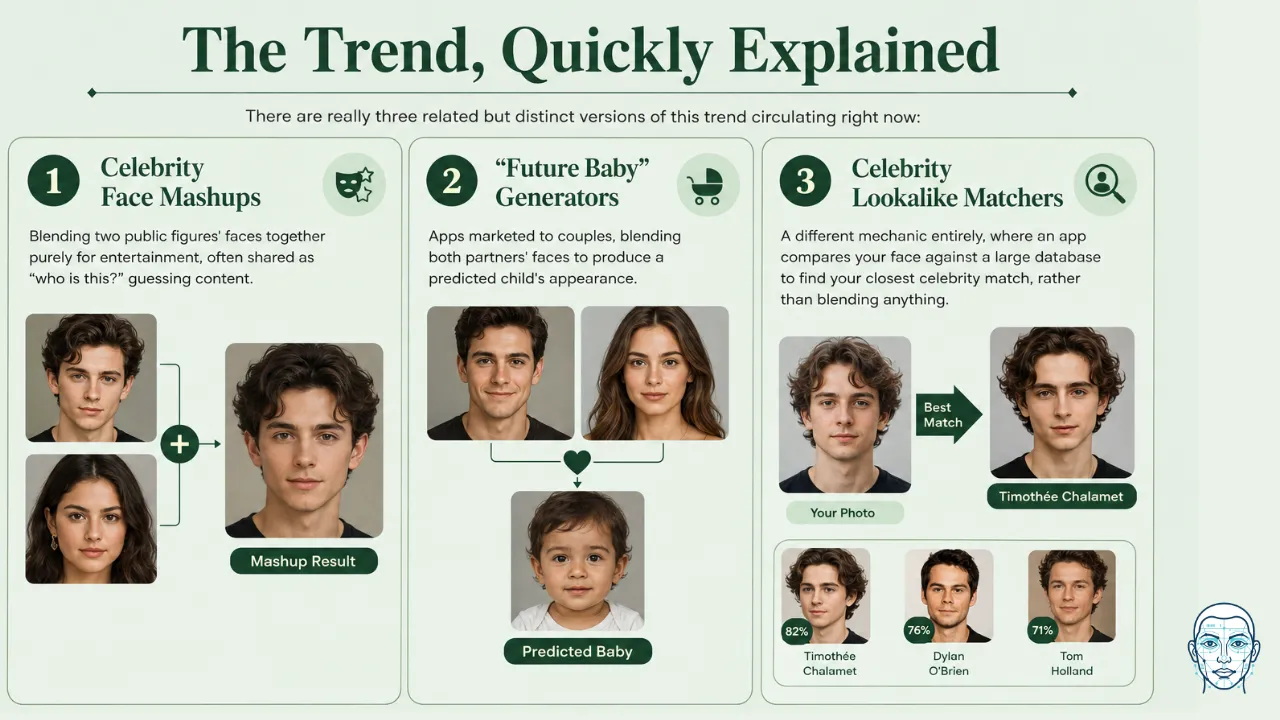
There are really three related but distinct versions of this trend circulating right now:
- Celebrity face mashups — blending two public figures’ faces together purely for entertainment, often shared as “who is this?” guessing content
- “Future baby” generators — apps marketed to couples, blending both partners’ faces to produce a predicted child’s appearance
- Celebrity lookalike matchers — a different mechanic entirely, where an app compares your face against a large database to find your closest celebrity match, rather than blending anything
All three feel similar on the surface, but only the first two actually involve genuine image blending. The lookalike matcher is closer to a search engine for faces than a blending tool.
How Face-Blending Apps Actually Work
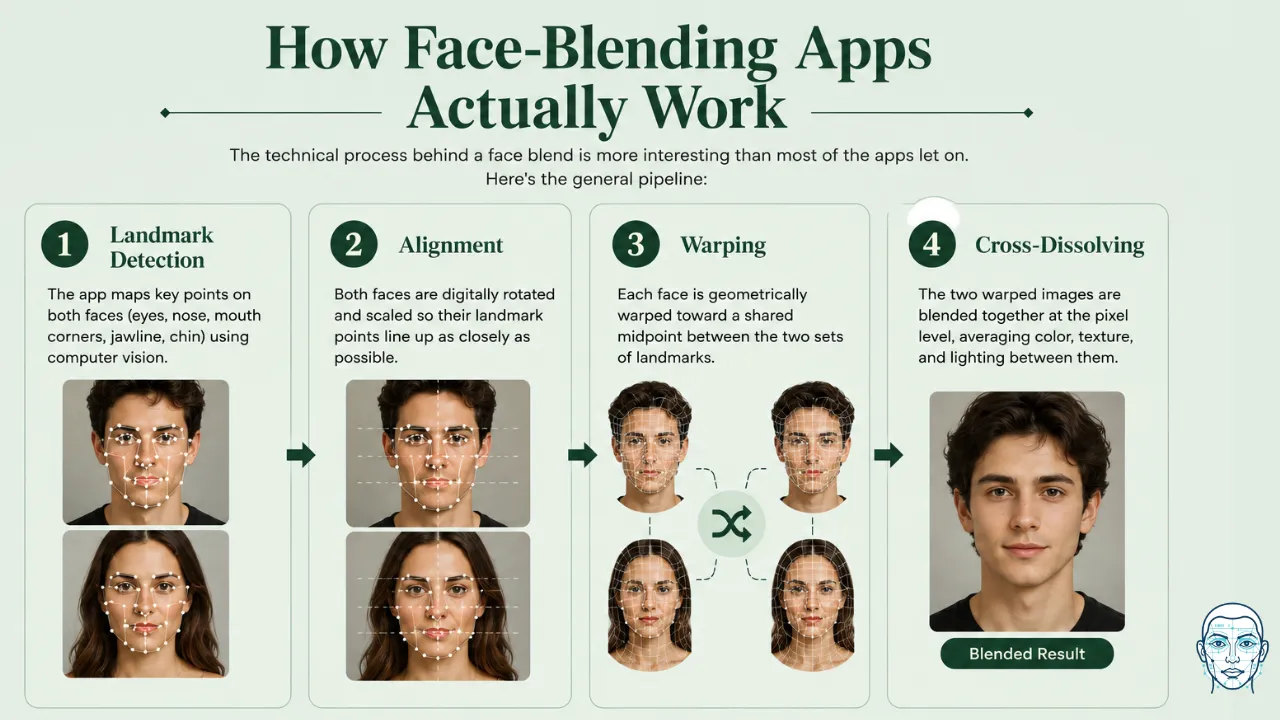
The technical process behind a face blend is more interesting than most of the apps let on. Here’s the general pipeline:
- Landmark detection — the app maps key points on both faces (eyes, nose, mouth corners, jawline, chin) using computer vision, the same basic category of technology behind a face shape detector.
- Alignment — both faces are digitally rotated and scaled so their landmark points line up as closely as possible, correcting for differences in head angle or photo framing.
- Warping — each face is geometrically warped toward a shared midpoint between the two sets of landmarks, essentially stretching and compressing each image until their structures partially match.
- Cross-dissolving — the two warped images are blended together at the pixel level, averaging color, texture, and lighting between them.
The result is a genuinely new image — not a literal average of two people’s real bone structure or genetics, but a photo-level average of two 2D pictures. That distinction matters a lot for understanding what the output actually represents.
The Real Science: Why “Averaged” Faces Often Look Pleasant
Here’s where there’s genuine, well-established research behind part of this trend. Face-perception research going back decades has consistently found that faces closer to a population’s mathematical average tend to be rated as more attractive than more distinctive or unusual faces — a finding often called the “averageness effect.” Researchers have demonstrated this directly by digitally averaging multiple faces together and finding that the composite images tend to be rated as more attractive than most of the individual faces that went into them.
The likely explanation isn’t mysterious or mystical — averaging tends to smooth out asymmetries, blemishes, and any individually unusual features, while blending textures in a way that reads as smoother, more symmetrical skin. So when a face-blend app produces a result that a lot of viewers find pleasant to look at, that’s a real, researched effect at work — not just a coincidence or app marketing.
That said, this research describes a general statistical tendency across large groups of faces, not a guarantee about any two specific photos blended together. A blend of two faces can just as easily land on an unusual, less-averaged combination depending on how different the two source faces are to begin with.
What Blending Apps Get Wrong (or Oversell)
A few things worth being clear-eyed about, since app marketing tends to overstate what’s actually happening:
“Future baby” generators aren’t genetic predictions. These tools blend two 2D photographs at the pixel and geometry level — they have no access to either person’s actual DNA, and no ability to model how genetic inheritance actually works (which traits are dominant, recessive, or polygenic, for instance). A blended photo is an artistic approximation at best, not a scientific prediction of what a future child would look like.
A face blend doesn’t reveal anything about real face shape. This is worth stating plainly for a site focused on genuine face shape science: a blended photo shows what an image-averaging algorithm produced from two pictures — it has no relationship to either person’s actual measured proportions, bone structure, or face shape category. If you’re genuinely curious about your own face shape, that requires an actual measurement-based tool, not a blending app.
Consistency between different apps is low. Because each app uses its own landmark-detection model, alignment method, and blending weight, the same two source photos run through different apps can produce noticeably different results — there’s no single “correct” blend, since the underlying algorithms aren’t standardized.
A Word on Consent and Deepfakes
This is worth addressing directly, since most coverage of this trend skips it entirely: blending or morphing someone’s face — celebrity or otherwise — without their knowledge or consent sits in ethically murky territory, and it’s part of the same broader technology category as deepfakes.
Public figures’ images are used constantly in this kind of content without any involvement from them, and while a comedic celebrity mashup is generally treated as harmless fun, the same underlying technology raises real concerns when applied to private individuals without their permission — for harassment, impersonation, or non-consensual imagery.
A reasonable line worth drawing for yourself: blending your own photo with a public figure’s for fun is different from creating or sharing a blended or morphed image of a private person, especially without their knowledge. If you wouldn’t want your own face used that way, it’s worth extending the same consideration to others.
What Actually Tells You Something Real About Your Face
If the part of this trend that genuinely interests you is understanding your own facial structure — not just making a fun composite image — a real face shape assessment gives you something a blending app fundamentally can’t: an actual measurement of your forehead, cheekbone, and jaw proportions, compared against defined categories, with real style implications for haircuts, glasses, and grooming.
Where a face-blend app produces a one-off image with no lasting information, a real face shape result tells you something durable and useful about your own proportions — the kind of thing you can actually act on, rather than just screenshot and share.
Quick Recap
Face-blending apps use real computer vision techniques — landmark detection, geometric warping, pixel-level blending — and the pleasant results they sometimes produce connect to genuine, well-researched science on facial averageness. But a blended photo isn’t a genetic prediction, doesn’t reveal anything about real face shape, and isn’t standardized between different apps. It’s a fun, photo-level effect — worth enjoying for what it actually is, and worth pairing with real consent awareness if you’re blending anyone other than yourself.
Frequently Asked Questions
How do face morphing apps actually work?
They map key facial landmarks on two photos, align and geometrically warp both images toward a shared midpoint, then blend the pixels together. The result is a new, computer-generated composite image, not a literal average of two people’s real facial structure.
Are “future baby” generator apps scientifically accurate?
No. These apps blend two 2D photographs visually — they have no access to either person’s actual DNA and can’t model real genetic inheritance. Any result is an artistic photo blend, not a genetic prediction.
Why do blended or averaged faces often look attractive?
Research on the “averageness effect” has found that faces closer to a population’s mathematical average tend to be rated as more attractive, likely because averaging smooths out asymmetries and blemishes while blending toward more symmetrical features. This is a real, studied effect, though it describes a general tendency, not a guarantee for any two specific blended photos.
Does a face blend tell me anything about my actual face shape?
No. A blended image is a pixel-level composite from an image-averaging algorithm — it has no connection to your actual measured proportions or face shape category. A real face shape assessment requires measuring your actual forehead, cheekbone, and jaw proportions.
Why do different face morph apps give different results for the same two photos?
Each app uses its own landmark-detection model, alignment method, and blending approach, so there’s no single standardized “correct” blend — the same source photos can look noticeably different depending on which app processes them.
Is it okay to blend my face with a celebrity’s photo?
Using a public figure’s widely available image for a lighthearted, clearly comedic blend is generally treated as harmless fun. The bigger ethical concern is applying the same technology to private individuals without their knowledge or consent, which overlaps with real deepfake concerns.
What’s the difference between a face morph app and a celebrity lookalike app?
A morphing app blends two images together into a new composite. A lookalike app compares your face against a large database to find your closest existing match — it doesn’t blend or alter any image at all.
If I want to actually understand my face shape, what should I use instead?
A dedicated face shape detector, which measures your real forehead, cheekbone, and jaw proportions against defined categories, gives you an actual, useful answer — unlike a blending app, which only produces a one-off composite image with no lasting measurement behind it.
See Your Face
Upload one photo and get your face shape — analyzed on your device, nothing ever uploaded anywhere.
Explore all tools →