
The 7 Face Shapes, Explained Simply
Every face falls somewhere on a spectrum of seven basic shapes. Here’s how to figure out yours — no dermatologist appointment required.
Your face shape isn’t really about beauty standards — it’s basic geometry. Four measurements (forehead, cheekbones, jaw, and length) combine in different proportions to create seven recognizable patterns that stylists, opticians, and makeup artists have relied on for decades. Once you know which pattern fits you best, choosing a hairstyle, picking glasses, or applying makeup stops being guesswork and starts being closer to a formula. This guide walks through all seven shapes in plain language, explains how the classification actually works, and points out the shape pairs people mix up most often. If you’d rather skip the manual measuring altogether, our AI tool can tell you in under thirty seconds.
What This Classification Actually Measures
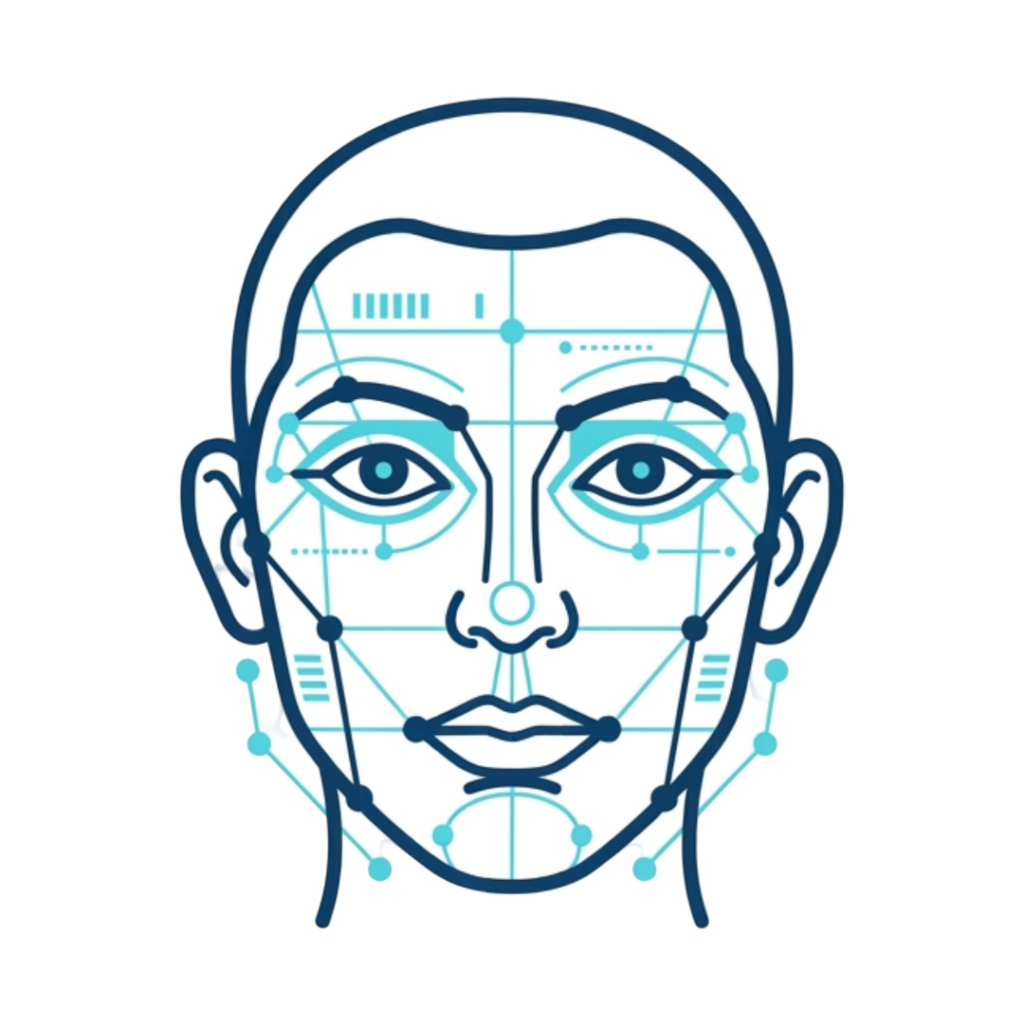
Every face shape system — including the one used here — comes down to comparing four measurements against each other:
- Forehead width
- Cheekbone width
- Jaw width
- Face length
None of these numbers mean anything on their own — what matters is the ratio between them. A face reads as “oval” not because of some fixed measurement in centimeters, but because its length runs roughly one and a half times its width, its cheekbones are the widest point, and its jaw curves rather than angles. Change any one of those relationships and you land in a different category entirely.
Set realistic expectations before you start: This is a useful approximation, not a medical diagnosis. Somewhere between a fifth and a third of people sit right on the boundary between two shapes rather than fitting cleanly into one box. If that sounds like you, don’t force a label — read both shape guides and take what applies.
One more honest note: most people are surprisingly bad at guessing their own face shape just by looking in a mirror. The single most common mistake is an oblong face mistaking itself for oval, simply because both shapes read as “longer than wide” at a glance. A tape measure — or an AI landmark scan — settles the question a lot faster than eyeballing it ever will.
A Quick Note on Rarity
You’ll see face shape “rarity” percentages floating around online, and it’s worth knowing where those numbers usually come from before you put much weight on them. Most of the time, they’re pulled from one tool’s own user base, not an independent population study — which means the results say more about who used that particular app than about humanity in general. What’s safe to say, and shows up consistently across independent sources, is simpler: oval and round tend to be the most commonly reported shapes, while diamond and triangle are consistently the least common. Treat anything more precise than that with a healthy dose of skepticism.
Why Bother Knowing Your Face Shape?
It’s a fair question — plenty of people go their whole lives never thinking about it and turn out fine. But knowing your shape does one specific thing well: it turns hairstyle and glasses shopping from trial-and-error into an educated starting point. Instead of trying on twelve frames and hoping one looks right, you can walk in already knowing that, say, angular frames tend to flatter your particular proportions, and skip straight to the styles worth trying.
It’s also useful context for talking to a stylist. Saying “I have a square face and want to soften my jawline a bit” gives a hairdresser far more to work with than “just something that suits me.” The classification isn’t magic — it’s shorthand that saves everyone time.
That said, it’s worth holding loosely. Face shape is one input among many — skin tone, hair texture, personal taste, and honestly what you feel confident in all matter just as much, if not more. Think of your shape as a helpful starting point for narrowing down options, not a set of rules to follow strictly.
How to Measure Yourself
You don’t need any special equipment for this — just a mirror, a flexible tape measure, and your hair pulled back off your face.
- Forehead: Measure straight across at the widest point, usually just above your eyebrows.
- Cheekbones: Measure from the outer edge of one cheekbone to the other, at their highest point.
- Jaw: Measure across the angles of your jaw, just below your ears.
- Length: Measure from your hairline straight down to the tip of your chin.
Once you have all four numbers, compare them. Find your widest measurement first — that alone narrows things down fast. Widest at the cheekbones usually points to oval, round, or diamond. Widest at the forehead points to heart. Widest at the jaw means triangle. And if all three widths come out close to equal, you’re looking at either square or oblong, with your length-to-width ratio breaking the tie.
All 7 Shapes, Side by Side
| Shape | Widest point | Length : Width | Chin |
|---|---|---|---|
| Oval | Cheekbones | ~1.5:1 | Rounded |
| Round | Cheekbones | ~1:1 | Rounded |
| Square | All roughly equal | ~1:1 | Square / flat |
| Heart | Forehead | Moderate | Pointed |
| Diamond | Cheekbones | Moderate | Pointed |
| Oblong | All roughly equal | ~1.7:1 or more | Flat |
| Triangle | Jawline | Moderate | Flat / broad |
The 7 Shapes
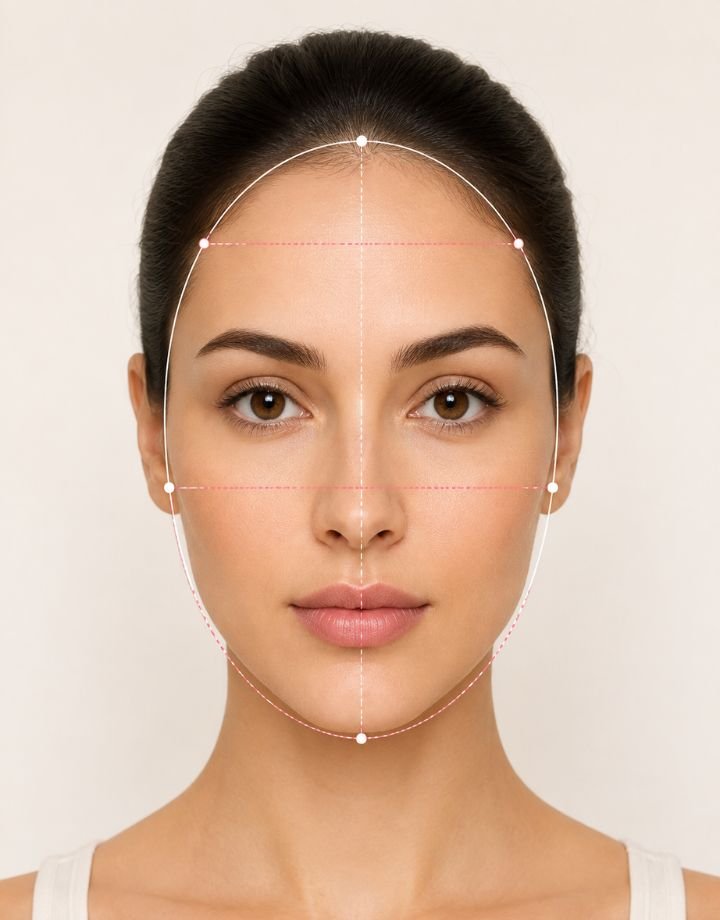
Oval
The most balanced of the seven shapes. Your face runs roughly one and a half times longer than it is wide, your cheekbones are the widest point, and your jaw tapers gently into a rounded chin — nothing dominates, and nothing really needs correcting.
Styling:This is the one shape that can wear almost anything. Bangs, no bangs, short crops, long waves, angular glasses, round glasses — nearly everything is fair game. If this is you, treat it as permission to experiment rather than a rulebook to follow.
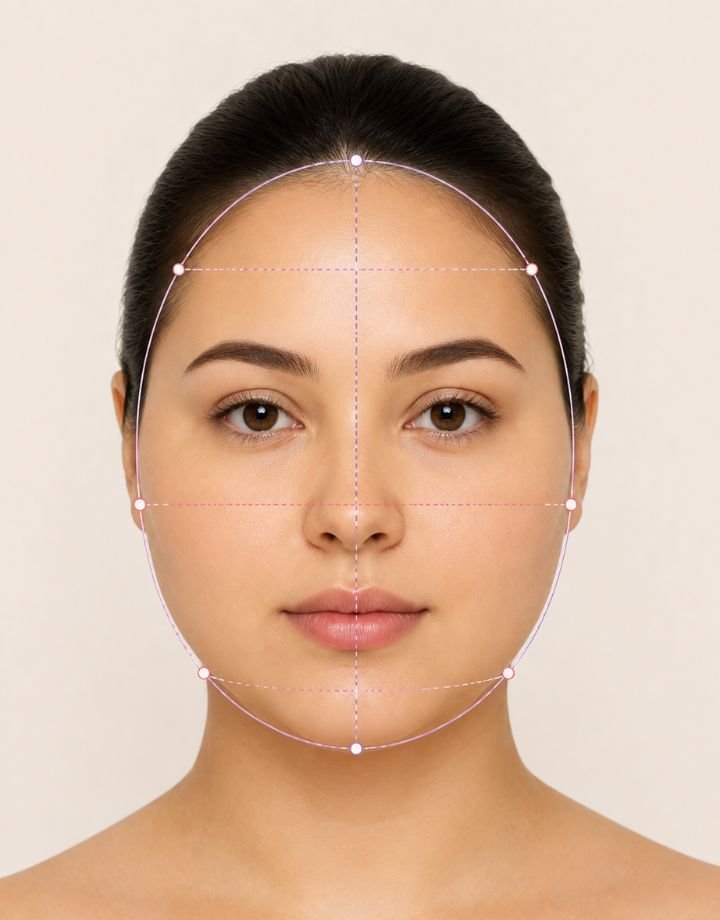
Round
Width and length sit close to equal, the cheeks are full, and the jaw curves softly with no angles anywhere. It’s the shape most often associated with a youthful look.
Styling: the general goal is adding a bit of vertical line. Height at the crown, layers that fall past the jaw, and side-swept parts all help elongate the face. Angular glasses frames do the same job, introducing contrast that a round face doesn’t naturally have.
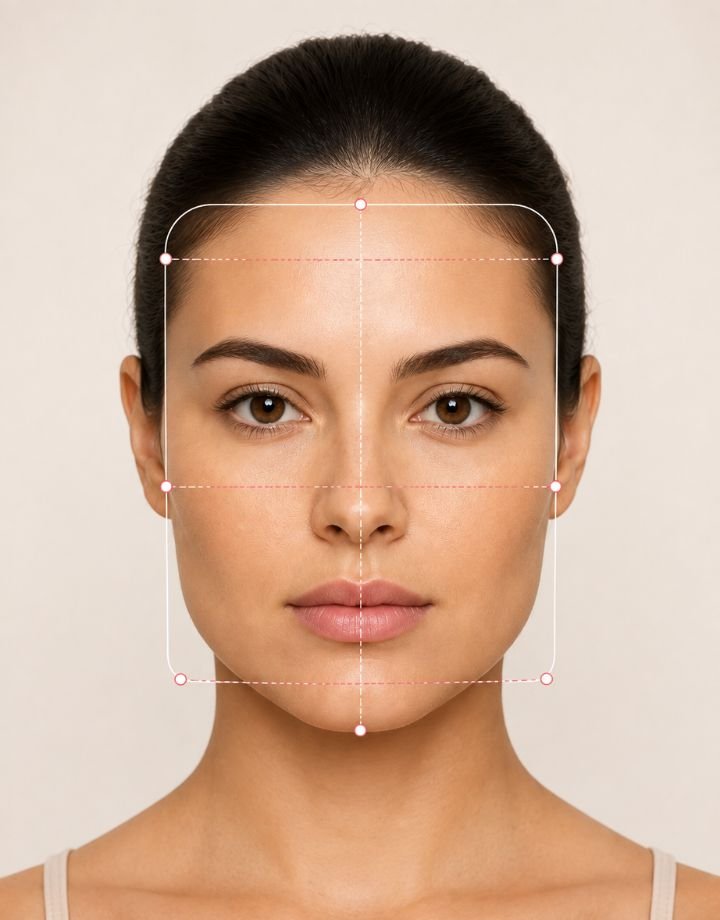
Square
Forehead, cheekbones, and jaw all sit close in width, and the defining feature is a strong, angular jawline with visible corners rather than a curve.
Styling: Most square-face styling aims to soften the jaw slightly without hiding it — soft layers, waves, or a side part, rather than anything blunt or heavy at jaw-level. Round or oval glasses frames work the same way, contrasting gently with the angles instead of matching them.
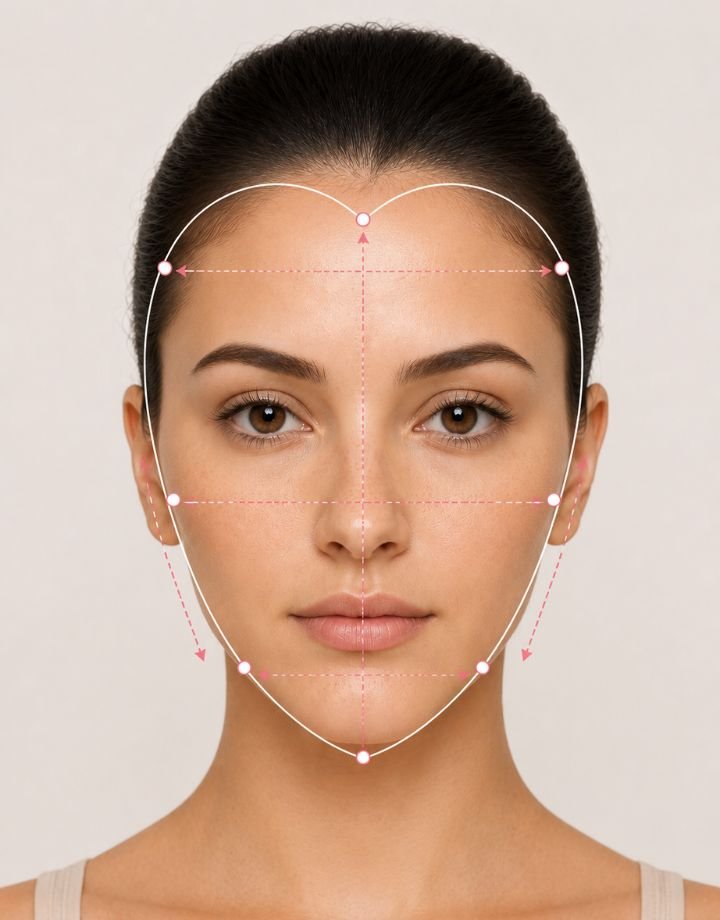
Heart
Wide at the forehead and cheekbones, narrowing sharply down to a pointed chin — often paired with a widow’s peak that emphasizes the shape further.
Styling: The goal is adding a little visual weight lower down to balance the width up top. Chin-length cuts, waves that sit around the jaw, and side-swept bangs (which break up forehead width) all work in this shape’s favor. Frames with a bit more detail along the bottom rim balance things out nicely too.
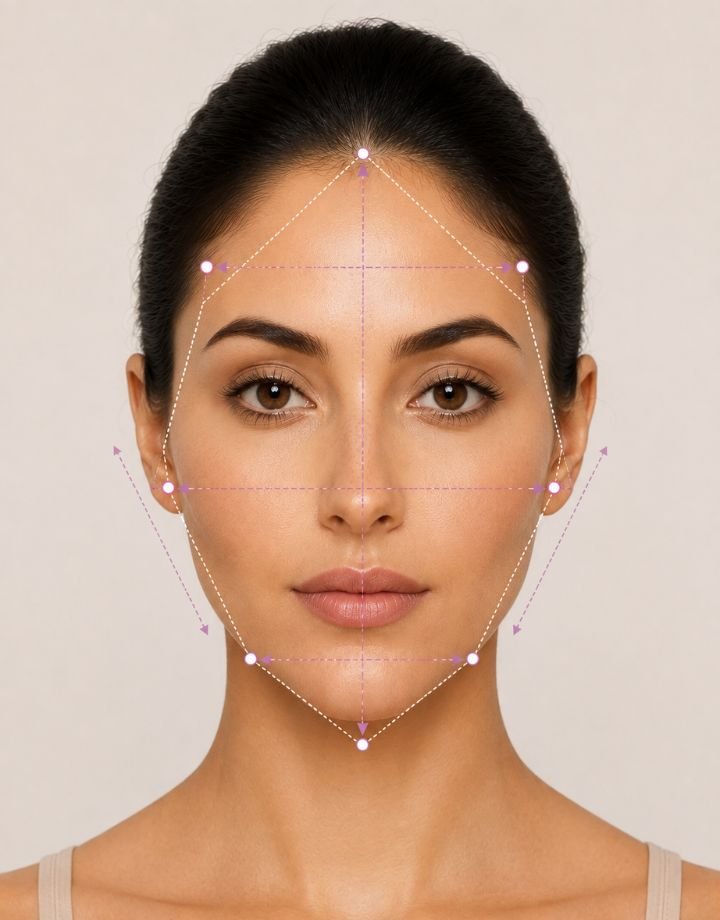
Diamond
The rarest of the seven. Cheekbones are clearly the widest point on the face, both the forehead and jaw are narrower, and the chin comes to a defined point.
Styling: The aim is softening the cheekbones while adding a little width at both ends. A side-swept fringe adds forehead width; waves that fall past the jaw do the same lower down. Oval or rimless glasses tend to work best here, since anything wide at cheek-level competes with your most prominent feature.
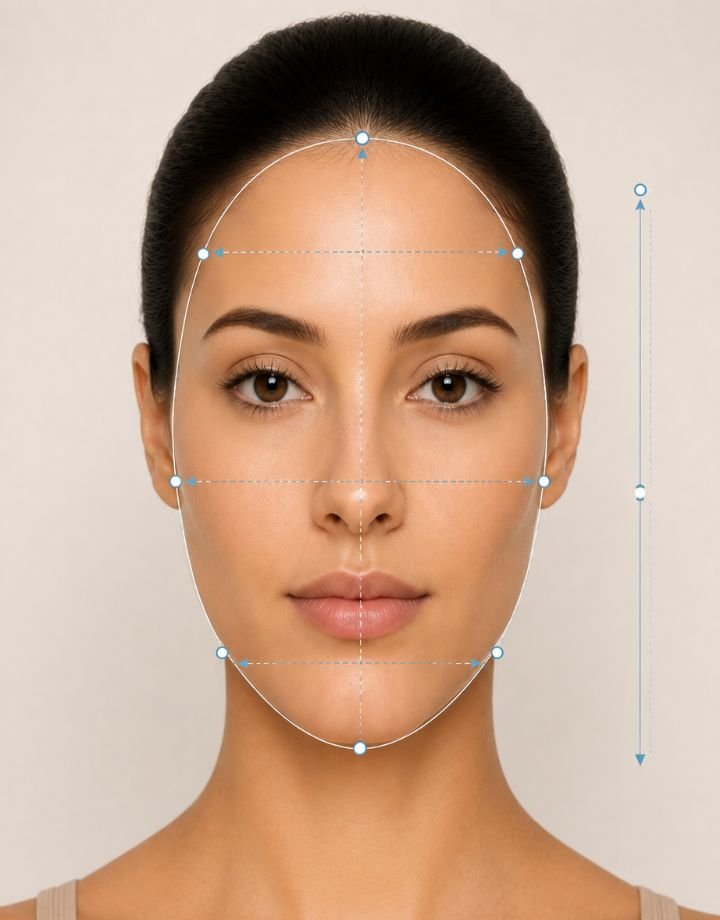
Oblong
Similar to square in that forehead, cheeks, and jaw are close in width — but the face runs noticeably longer, with straighter cheek lines than an oval has.
Styling: Everything here is about adding width and breaking up length. Fringes, side waves, and cuts with volume around cheek-height all help. A flat center part with no side volume tends to stretch the face even further, so it’s usually worth avoiding.
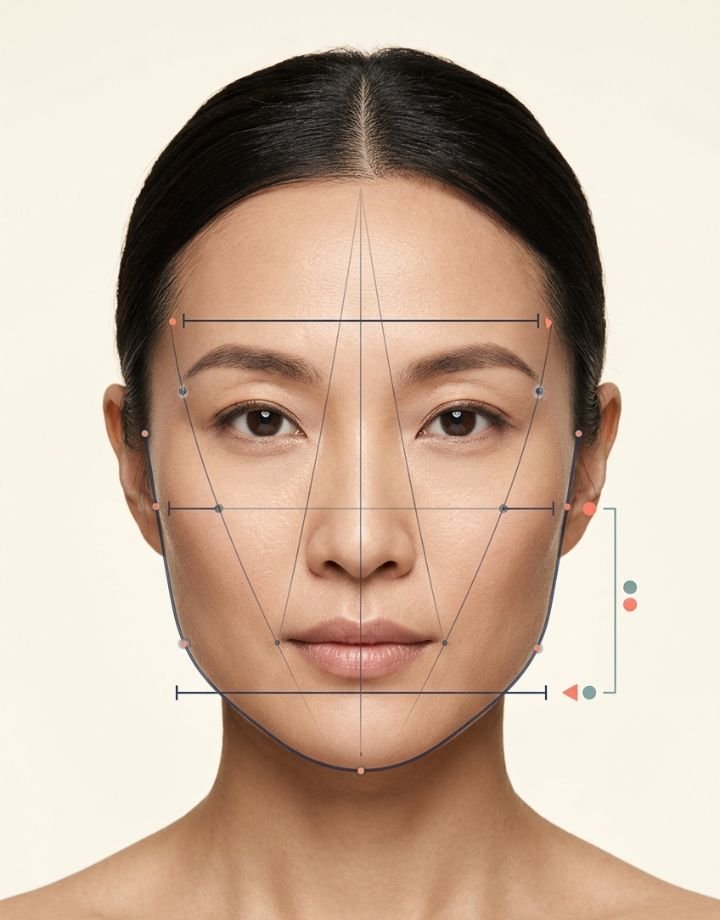
Triangle
The exact opposite of heart — narrow at the forehead, widening steadily down to the jaw, which ends up being the widest point on the face. By most estimates, genuinely the rarest shape of the seven.
Styling: Volume belongs at the top here — around the crown and temples — to balance the wider jaw below. Styles that stay short at jaw-level, rather than resting right on it, keep attention from settling on your widest point. Frames with more detail near the top, like browline styles, do the same job.
The 7 Face Shapes
Here’s a quick look at the face shapes
Oval
Square
Heart
Diamond
Oblong
Triangle
Shapes People Mix Up Most
Oval vs Oblong
Both read as “longer than wide” at a glance, which is exactly why people confuse them. The real tell is the ratio: oval sits around 1.5:1 (length to width), while oblong runs noticeably higher. The cheek line is the second clue — oval curves in gently, oblong stays fairly straight.
Round vs Square
These two share almost identical width-to-length ratios, so the jaw is really the only thing separating them. Soft and curved with no corners means round. Sharp, defined, and angular means square.
Frequently Asked Questions
What’s the most common face shape?
Oval and round both show up more often than the other five shapes across most independent sources, though exact percentages vary a lot depending on who’s measuring and how.
Can my face shape change over time?
The underlying bone structure stays fairly stable once you’re an adult, but weight changes, aging, and even how you style your hair can shift how a face reads day to day — part of why self-assessment is trickier than it sounds.
How accurate is an AI face shape detector?
A model that maps dozens or hundreds of facial landmarks applies the same ratio calculations consistently every time, which removes a lot of the guesswork that comes with eyeballing it in a mirror.
What if I don’t fit neatly into one shape?
Completely normal — a real share of people sit right at the boundary between two adjacent shapes. Read both guides and borrow the styling advice that actually addresses your specific features.
Does face shape actually matter for hairstyles and glasses?
For those two decisions specifically, yes — there’s a genuinely solid case for it. Advice on contouring and accessories built around face shape tends to be more general and a little less precise.
Skip the tape measure
Upload a photo and our AI maps your face in seconds — shape, confidence score, and personalized hairstyle and glasses recommendations, all processed on your device.
Try the Face Shape Detector →