
Face Shape Quiz: Answer 7 Questions to Find Out
Answer 7 quick questions about your forehead, cheekbones, jawline, and chin to get an instant face shape suggestion — oval, round, square, heart, diamond, oblong, or triangle. No photo required, just answer honestly.
Searching “what face shape do I have” usually means you’re trying to solve a specific problem — a haircut that isn’t landing right, glasses that never quite fit, or just plain curiosity about a feature you look at every day but rarely study. A face shape quiz exists to answer that question fast, without a tape measure or an awkward photo upload. Below, you’ll find the quiz itself, an explanation of exactly how it scores your answers, a full breakdown of all 7 shapes, and answers to the questions people ask most before and after taking it.
Quick Answer
A face shape quiz is a 7-question self-assessment that estimates your face shape from your forehead width, cheekbone prominence, jawline, and chin shape — no photo needed. It takes about a minute, scores your answers against all 7 face shapes, and is free with unlimited retakes. For a more precise, measurement-based result, an AI photo detector analyzes an actual photo instead of self-reported answers.
Take the Quiz
How the Face Shape Quiz Works
From seven questions to a suggested shape — here’s what happens behind the scenes.
Answer 7 quick questions
Face length vs. width, forehead width, cheekbone prominence, jawline, and chin shape — the same core features used to tell face shapes apart.
Scored across all 7 shapes
Each answer carries weighted points toward multiple shapes at once. Your seven answers combine into a running score for all 7 shapes simultaneously.
See your suggested shape
The highest-scoring shape is shown first. A close second is surfaced if two shapes score nearly equally — common, since many faces sit near a border.
Get full styling guidance
Your result links straight to that shape’s full guide — characteristics, hairstyles, and glasses tips — or try the AI photo detector for more precision.
The 7 Face Shapes
Here’s a quick look at the face shapes
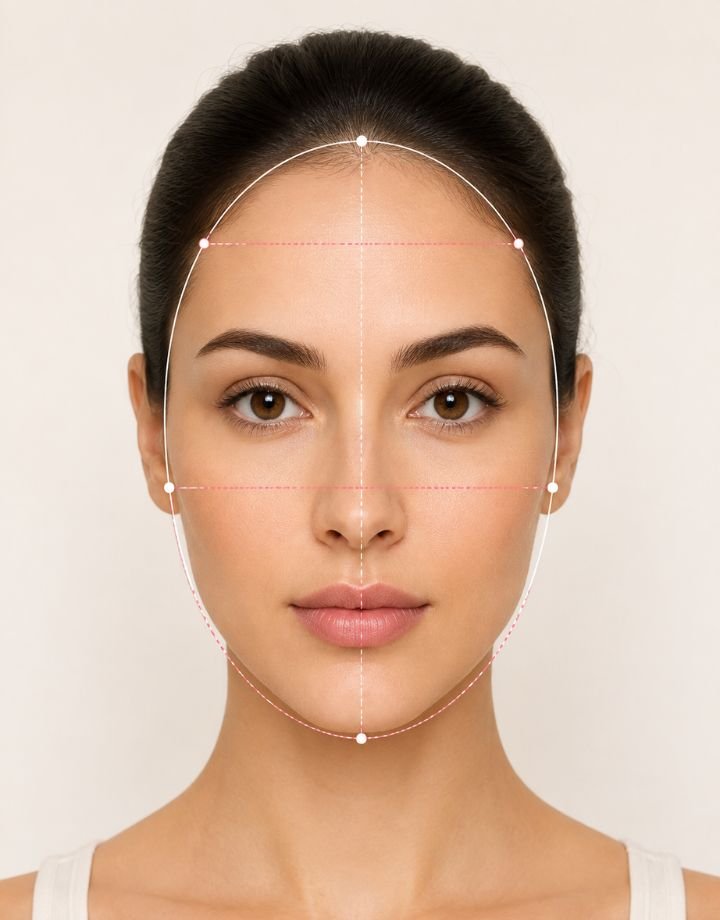
Oval
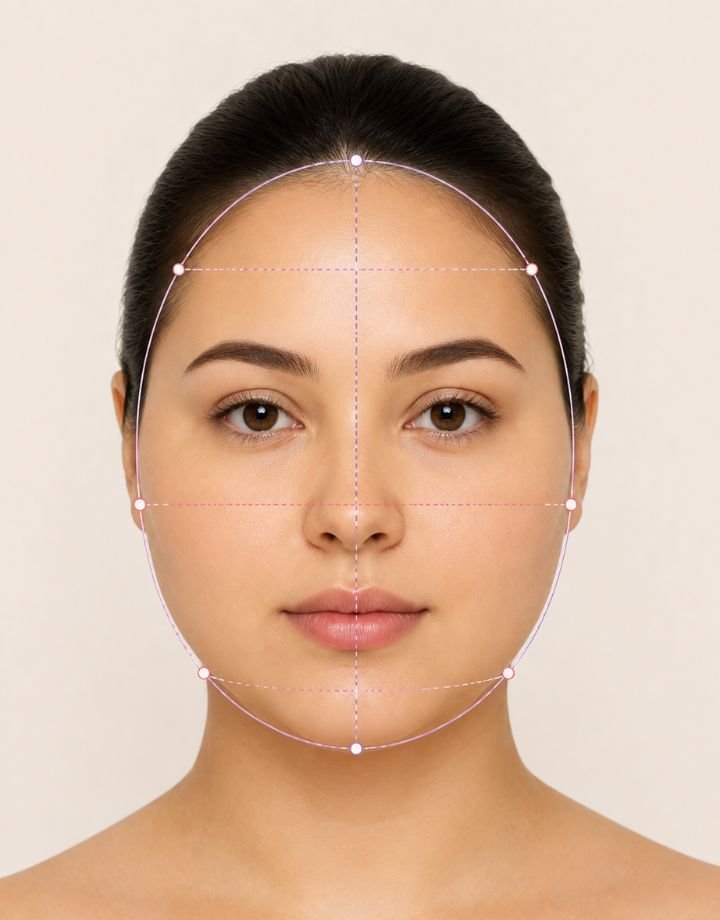
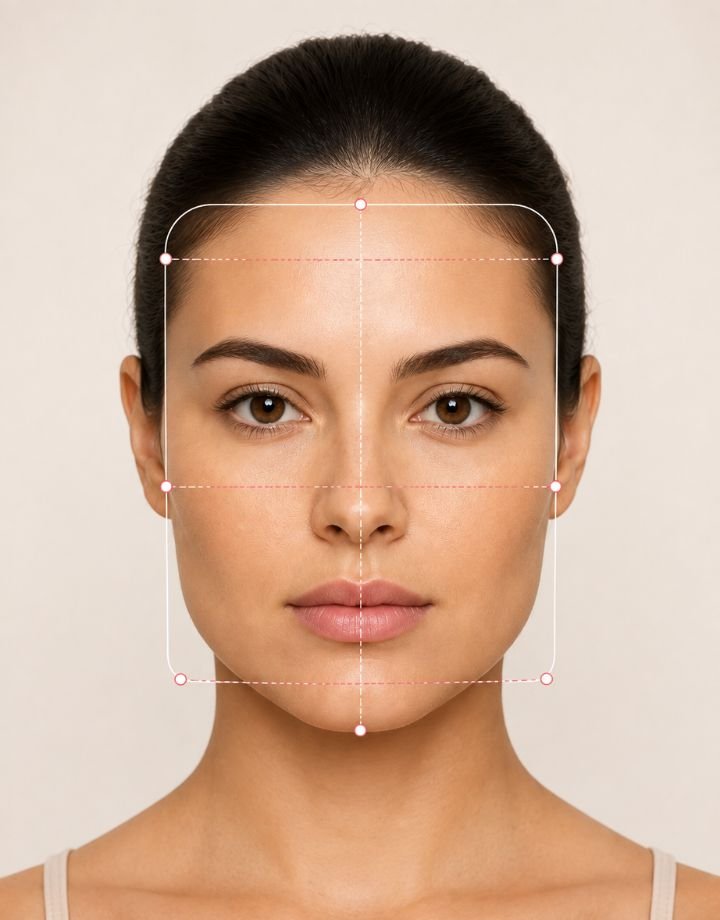
Square
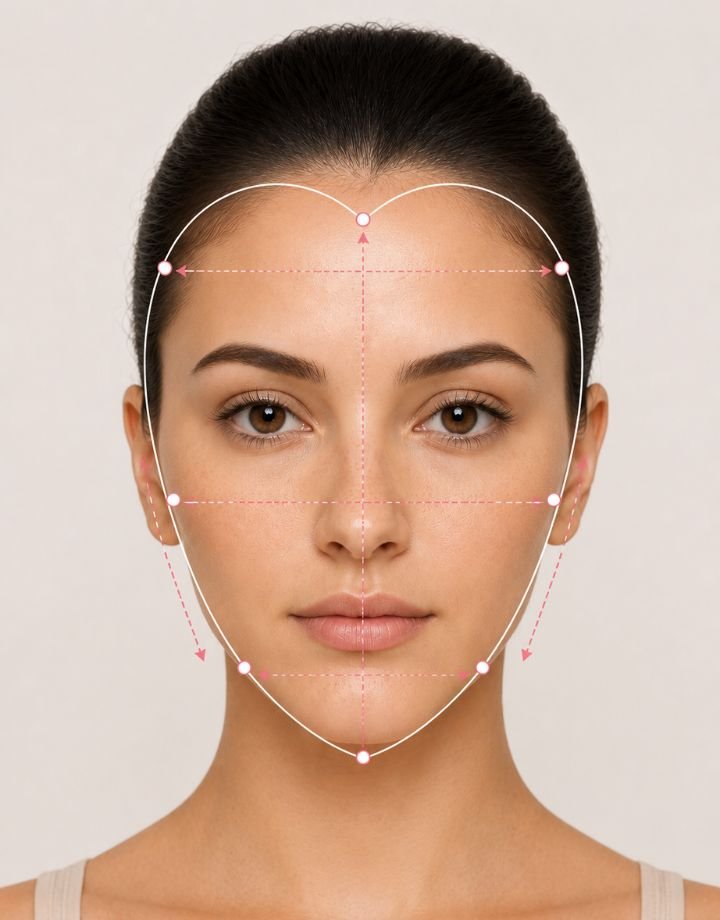
Heart
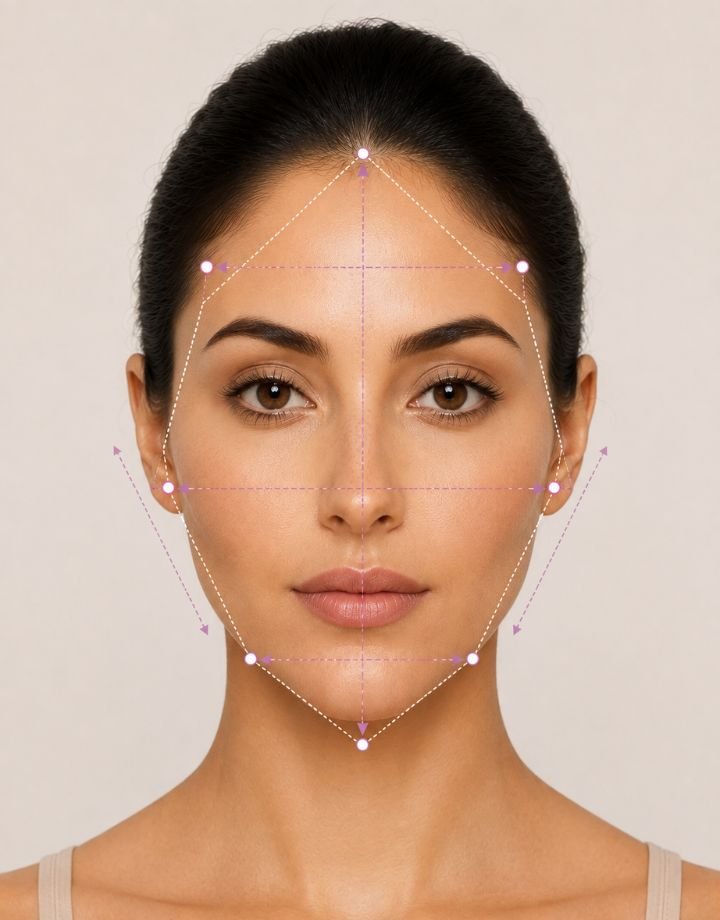
Diamond
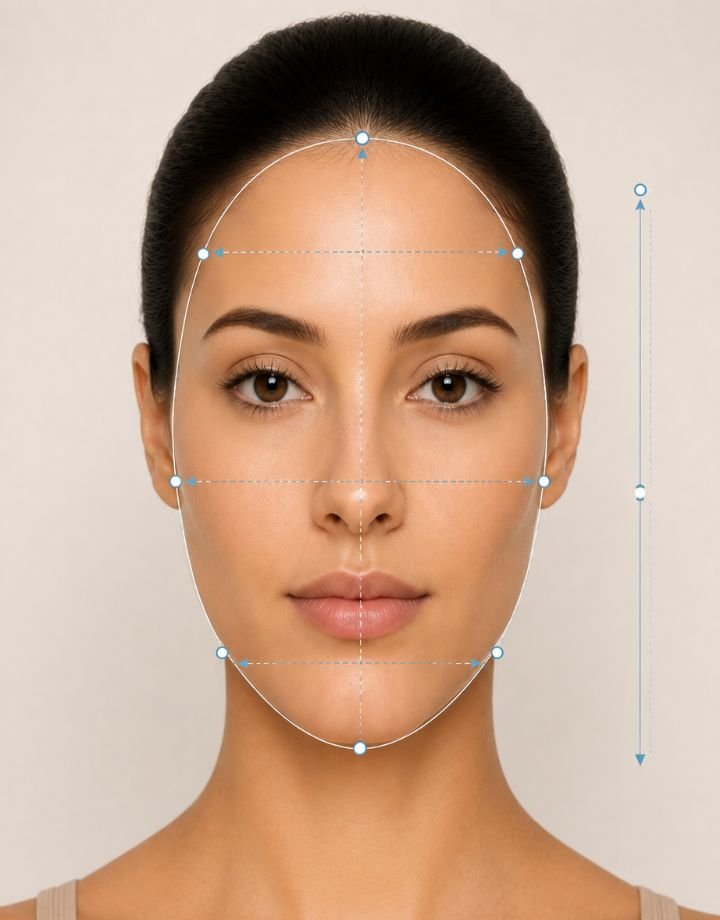
Oblong
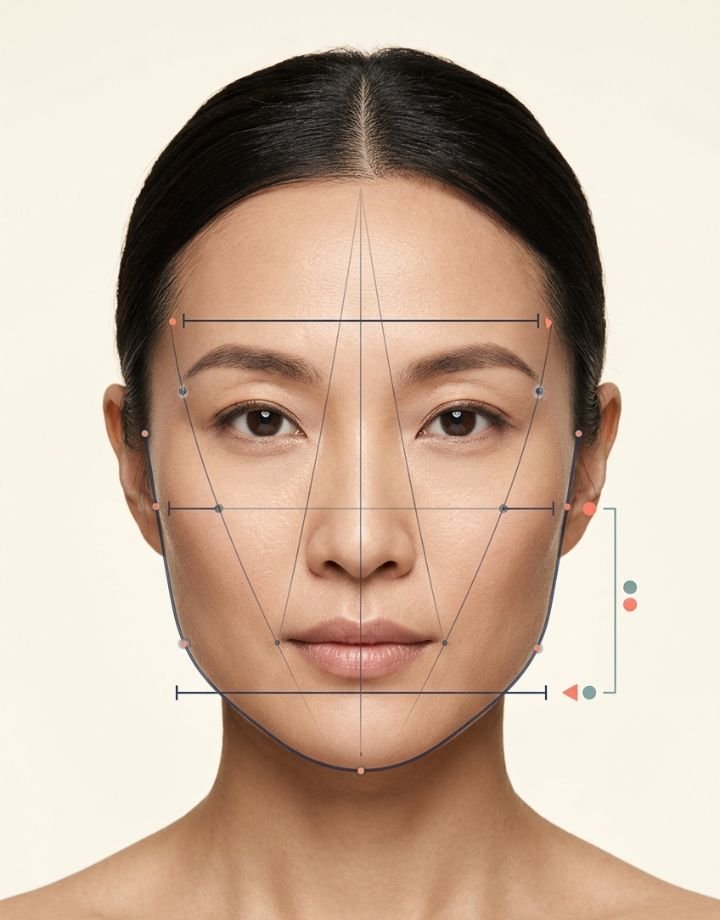
Triangle
Want the full breakdown of all 7? Read the complete face shapes guide →
A little more detail on each, since the one-line summaries above only tell part of the story. Oval faces run about one and a half times longer than wide, with cheekbones as the widest point and a gently curved jaw — the reason stylists often call it the “easiest” shape to work with. Round faces have width and length close to equal, with fuller cheeks and no sharp angles anywhere. Square faces share that same near-equal width and length, but the defining trait is a strong, angular jaw with visible corners rather than a curve.
Heart-shaped faces are widest at the forehead and cheekbones, narrowing sharply to a pointed chin, often with a slight widow’s peak. Diamond faces are the rarest of the seven — cheekbones are clearly the widest point, with both the forehead and jaw narrower, ending in a defined chin. Oblong faces resemble square in width proportions but run noticeably longer, with straighter cheek lines than oval’s inward curve. Triangle faces are the mirror image of heart — narrow at the forehead, widening steadily down to a broad jaw.
Why Knowing Your Face Shape Actually Matters
It’s a fair question — plenty of people never think about this and get along fine. But face shape earns its place for two specific decisions: haircuts and glasses. Knowing you’re square rather than round tells a stylist exactly where to add softness; knowing you’re oval rather than diamond changes which glasses frames will actually sit well rather than fight your proportions. It turns a dozen trial-and-error tries into an informed starting point.
It’s worth holding loosely, though. Face shape is one input among several — skin tone, hair texture, and what you personally feel confident in all matter just as much. Treat your quiz result as a useful shortcut, not a rulebook you’re obligated to follow.
Face Shape Quiz for Women and Men
The quiz itself works identically regardless of gender — forehead width, cheekbone prominence, and jawline are purely structural measurements that don’t change based on who’s answering. What can differ afterward is the styling guidance your result links to: hairstyle and glasses recommendations are sometimes split by preference, but the underlying face shape scoring never changes. If you’re taking this as a face shape quiz for women or specifically looking for a men’s version, you’re taking the exact same 7 questions either way — only the linked style guide adjusts.
How to Get an Accurate Result
Most off-target results come from how a question gets read, not the framework itself. A quiz is only as good as the honesty and clarity of the answers going into it — unlike a photo-based measurement, there’s no independent check on whether “prominent cheekbones” means the same thing to you as it does to the person who wrote the question. Keep these in mind as you answer.
Get the Most Accurate Quiz Result
- ✓Answer for your bone structure, not hair or makeup — bangs and contouring can visually change your outline.
- ✓It’s fine to sit between two answers. If two options feel equally true, pick the slightly more dominant one.
- ✓Use a mirror in good, even lighting — angle and shadows distort how wide your forehead or jaw appear.
- ✓Pull your hair back before answering so your hairline and jaw are both fully visible.
- ✓If your result feels off, retake it reading each question more literally, or try the AI photo detector instead.
Face Shape Quiz vs. AI Photo Detector
Both answer the same question, but they get there differently — and it’s worth knowing which one fits what you actually need right now.
Face Shape Quiz
A self-answered questionnaire — no photo, no upload. You judge your own forehead width, cheekbone prominence, and jawline, and the quiz scores your answers against all 7 shapes. Faster to start, but only as accurate as your own read of your features.
AI Photo Detector
Analyzes an actual photo using facial landmark measurements — real ratios between your forehead, cheekbone, and jaw width, not self-perception. More precise, especially for borderline faces, since it removes the guesswork of judging your own proportions.
A reasonable approach: take the quiz for a fast first read, then confirm with the AI photo detector if the result doesn’t feel quite right or you want a more precise, measurement-based answer.
Methodology & Scoring Notes
This quiz asks 7 questions about your face length, forehead width, cheekbone prominence, jawline, and chin shape, then scores your answers against all 7 face shapes to suggest the closest match. Each answer option is pre-weighted with points toward one or more shapes — a “strong, angular jawline” answer, for instance, adds points to Square and a smaller amount to Oblong, since both shapes share that trait to different degrees.
After all 7 questions, the points are totaled per shape and sorted. If two shapes score nearly equally, the result shows both rather than forcing a single answer — this reflects a genuine, common reality: a real share of faces blend features from two adjacent shapes rather than fitting one category perfectly.
Everything runs entirely in your browser. No photo, sign-up, or upload is required, and nothing you answer is sent anywhere or stored — the scoring happens locally on your own device the moment you click through each question, and the result disappears the moment you close or refresh the page unless you choose to act on it.
How to Tell Your Face Shape Without This Quiz
If you’d rather work it out by hand before or after taking the quiz, you only need a mirror, or a tape measure for more precision.
- By eye: Look straight into a mirror with your hair pulled back. Find your widest feature first — forehead, cheekbones, or jaw — since that alone points toward two or three likely shapes.
- By measurement: Measure across your forehead, cheekbones, and jaw, plus your face length from hairline to chin. Compare the three widths, then check your length-to-width ratio — a face roughly 1.5 times longer than wide, widest at the cheekbones, points toward oval.
Both methods are exactly what this quiz automates into seven simple questions — it’s the same logic, just without needing a tape measure or the trained eye to interpret raw numbers yourself.
Shapes People Often Confuse in This Quiz
- Oval vs. Oblong. Both read as “longer than wide.” The tell is degree — oval runs about 1.5:1 length to width, oblong noticeably more, with straighter cheek lines than oval’s gentle curve.
- Round vs. Square. These share a near-identical width-to-length ratio. The jawline is the deciding factor: soft and curved means round, sharp and angular means square.
- Heart vs. Diamond. Both taper toward the chin. Heart is widest at the forehead; diamond is widest at the cheekbones, with both the forehead and jaw narrower than the cheeks.
- Heart vs. Triangle. Genuine mirror images. Whichever end is wider decides it — wide forehead and narrow jaw means heart; narrow forehead and wide jaw means triangle.
A Worked Example: How Scoring Plays Out
Seeing the math in action makes the “why” behind your result much clearer. Say someone answers: face slightly longer than wide, forehead and jaw about equal width, cheekbones noticeable but not prominent, a softly rounded jawline, a rounded chin, a curved and soft outline, and “balanced” as their one-word pick.
Running through the weights: Oval picks up points from five of those seven answers (the length ratio, the moderate cheekbones, the rounded chin, the soft outline, and the final word choice), while Round and Square each pick up a couple of points from the equal-width answer and the rounded jaw. After all seven questions are totaled, Oval comes out clearly ahead — not because any single answer was decisive, but because it was the most consistent thread running through all seven. That’s the actual mechanism behind “your answers combine into a running score” — no single question can single-handedly decide your result, which is what makes the quiz reasonably resistant to one ambiguous answer throwing the whole thing off.
This also explains why close results happen: if that same person had answered “strong and angular” for the jawline instead of “softly rounded,” Square would have picked up enough points to land within a few points of Oval’s total — triggering the close-second display instead of a single clean answer.
Why Seven Questions, Specifically
Seven isn’t an arbitrary number — it maps to the actual measurements used to define a face shape in the first place: face length versus width, forehead width, cheekbone prominence, jawline shape, chin shape, overall outline, and a final gut-check question that catches anything the first six didn’t fully capture. Fewer questions and the quiz starts guessing; more, and it risks asking about the same underlying trait twice in different words without adding real signal. Some quizzes elsewhere use five or six questions instead — that’s a reasonable design choice too, just a slightly different tradeoff between speed and the number of independent data points feeding the result.
Common Misconceptions About Face Shape Quizzes
A few assumptions trip people up before they even start. First: a quiz result isn’t meant to be permanent or clinical — it’s a structured estimate built from self-reported answers, and its whole value is speed and accessibility, not lab-grade precision. Second: getting a different result on a retake doesn’t mean the quiz is broken. It usually means an answer or two got read differently the second time, which is exactly the kind of variance that comes with self-assessment rather than measurement.
Third, and worth repeating: there’s no single “correct” number of face shapes across the internet. Most sources, including this one, use seven categories, but you’ll occasionally see five or six-shape systems that fold oblong into square or drop triangle entirely, reasoning that it’s rare enough not to need its own category. Neither approach is wrong — they’re just different levels of granularity for the same underlying idea, and it’s worth not being thrown off if a different site’s system doesn’t map perfectly onto this one.
What to Do With Your Result
Once you have a shape, the most useful next step is reading its full guide rather than stopping at the label itself. Each of the 7 shapes has its own set of styling logic — where to add volume, which glasses frames balance your proportions, which cuts tend to fight your natural structure rather than work with it. Your quiz result links directly to that guide, and if you landed on a close call between two shapes, it’s worth reading both, since real faces blending two shapes is common enough that the quiz is specifically built to catch it rather than force a single answer.
Frequently Asked Questions
How accurate is this face shape quiz?
This is a simplified 7-question indicator, not a photo-based measurement. It scores your answers against all 7 face shapes and surfaces the closest match, plus a close second when your answers land near a border. For a more precise, measurement-based result, try an AI photo face shape detector instead.
How many questions does the face shape quiz have?
This quiz has 7 questions covering face length vs. width, forehead width, cheekbone prominence, jawline shape, and chin shape — the core factors used to tell the 7 face shapes apart. It takes about a minute to complete.
Do I need to upload a photo to take this quiz?
No. This is a question-based quiz, not a photo analysis tool — you answer 7 questions about your features and get an instant result. Nothing is uploaded, and it runs entirely in your browser.
What’s the difference between this quiz and an AI face shape detector?
This quiz is a self-answered questionnaire — no photo needed, just seven quick questions. An AI face shape detector instead analyzes an actual photo using computer vision for a more precise, measurement-based result. Use the quiz for a quick estimate, the detector for more accuracy.
What does it mean if I get a close result between two face shapes?
It means your answers scored two shapes nearly equally — common, since many faces blend features of two shapes rather than fitting one perfectly. When this happens, the result shows both shapes so you can compare their guides and decide which resonates more.
Can I retake the face shape quiz?
Yes — use the “Retake the quiz” button on your result screen, or scroll back up and start again anytime. There’s no limit on retakes and no account or sign-up required.
Is the face shape quiz free?
Yes, completely free with no sign-up, account, or payment required, and no limit on how many times you take it.
How is my face shape calculated from my answers?
Each answer option carries weighted points toward one or more of the 7 face shapes. After all 7 questions, the points are totaled per shape and sorted — the highest-scoring shape is your result, with a close second shown if another shape scored within a small margin.
Is a face shape quiz as accurate as an AI photo detector?
No — a quiz depends on how accurately you judge your own features, which is genuinely difficult to do objectively. A photo-based detector measures real proportions from landmark points, removing most of that self-perception bias. Think of the quiz as a fast first estimate, not a final answer.
Does this quiz work for men and women equally?
Yes. Face shape is determined by bone structure and proportion, which the quiz questions measure the same way regardless of gender — only the styling guidance linked from your result may differ by preference.
What if none of the answer options feel exactly right?
Pick whichever option is closest to true rather than skipping ahead — the scoring system is built to handle imperfect matches by spreading points across shapes rather than requiring a perfect fit. If your final result still feels off after answering as accurately as you can, that’s a good signal to try the AI photo detector instead, which measures rather than estimates.
Can I use this face shape quiz to choose glasses or a haircut?
Yes — that’s the main practical use of a face shape result. Once you have your shape, the linked guide includes specific hairstyle and glasses recommendations built around that shape’s proportions, rather than generic advice that doesn’t account for your particular structure.
Want a more precise result?
Upload a photo and our AI maps your actual facial landmarks for a measurement-based face shape — no guessing required.
Try the AI Face Shape Detector →