Of all the face shape mix-ups people ask about, oval versus round tops the list. It makes sense — both shapes are curved, both lack sharp angles, and at a quick glance in the mirror, they can look nearly identical. But once you know the two things that actually separate them, telling them apart takes about two seconds.
This guide walks through exactly what those two things are, how to check them on your own face, and what to do differently depending on which one you have.
The Core Difference, in One Sentence
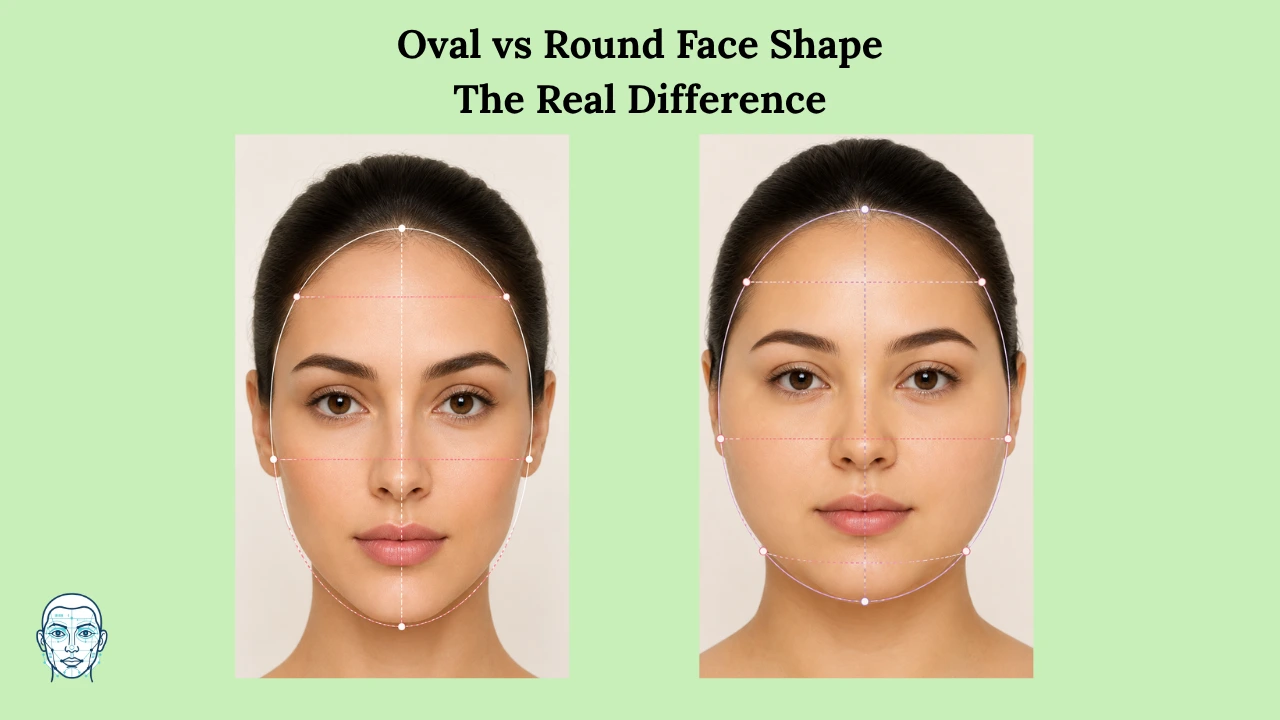
Here’s the short version: oval faces are noticeably longer than they are wide, while round faces have a length and width that are close to equal. That’s it. Everything else — cheek fullness, jaw softness, forehead shape — tends to follow from that one proportion.
Both shapes share a soft, rounded jawline with no sharp corners, which is exactly why they get confused. The difference isn’t in how curved the jaw is — it’s in how much longer the face is compared to how wide it is.
What Makes a Face Oval
An oval face is proportioned so that its length is clearly greater than its width — think of a gently elongated egg shape rather than a circle. A few features usually go along with this:
- The cheekbones are typically the widest point of the face
- The jaw tapers gently toward a rounded chin, without being sharp or angular
- The forehead is usually a little narrower than the cheekbones
- The overall shape looks balanced from top to bottom, without any one feature standing out
Oval is often described as the most “flexible” face shape for styling, simply because no single feature is dominant enough to require correcting.
What Makes a Face Round
A round face has a length and width that are close to equal, giving it a shape that reads more like a circle than an egg. The features that typically come with this:
- Full, soft cheeks that are often the widest part of the face
- A rounded jawline and chin with no angular definition
- A forehead that’s usually a similar width to the cheekbones
- An overall youthful, soft impression, since there’s no elongation or sharp structure
The key word for a round face is equal — width and length sit close together, rather than one clearly outweighing the other.
Oval vs Round: Side-by-Side Comparison
| Feature | Oval | Round |
| Length vs. width | Length clearly greater | Length and width close to equal |
| Widest point | Cheekbones | Cheeks (often fuller) |
| Jawline | Gentle taper, soft | Rounded, soft, no taper |
| Overall impression | Elongated, balanced | Circular, full |
| Styling goal | None needed — flexible | Add visual length |
The Quick Measurement Test
If you’re genuinely unsure which one you have, this takes under a minute with a soft tape measure (or a piece of string and a ruler):
- Measure your face length — from the center of your hairline straight down to your chin tip.
- Measure your face width — across the widest point, usually your cheekbones. Keep the tape flat rather than curved against your skin.
- Divide length by width.
Here’s how to read the result:
- Around 1.5 or higher → you’re solidly in oval territory.
- Around 1.0 to 1.1 → you’re solidly round.
- Somewhere around 1.2 to 1.3 → you’re in the blend zone between the two (more on this below).
This single ratio does more work than any visual guess, since it’s the actual measurement both shapes are defined by.
What If You’re Between the Two?
A genuinely large number of people land in that 1.2–1.3 range, with moderate cheek fullness and a jawline that has a little more definition than a purely round face but less taper than a purely oval one. This is completely normal — think of it as an “oval-round” blend rather than a measuring mistake.
If that’s you, the practical approach is to borrow styling tips from both categories: you’ll have a bit more flexibility than someone with a strongly round face, but slightly more benefit from length-adding styles than someone with a strongly oval one.
Best Hairstyles: Oval vs Round
For oval faces, almost anything works, since there’s no proportion that needs correcting:
- Center parts, side parts, or no part at all
- Full bangs or curtain fringe — both suit the shape equally well
- Any length, from a pixie cut to long layers
For round faces, the general goal is to add visual length and avoid adding extra width:
- Long layers that fall past the jawline elongate the face
- Height and volume at the crown or roots creates a vertical line
- Side-swept, off-center parts break up the roundness
- Best to avoid: chin-length blunt bobs (they end right at the widest point), heavy blunt bangs (they shorten the face), and very short, flat cuts with no height
Best Glasses: Oval vs Round
Oval faces can wear nearly any frame shape — round, square, cat-eye, aviator — without needing to correct anything.
Round faces benefit from frames with more angularity: rectangular, square, or wayfarer shapes add the structure and definition a round face doesn’t have on its own. Frames that are noticeably wider than the face also help elongate it visually.
Makeup Differences
Oval faces need minimal contouring — since the proportions are already balanced, a light touch is usually enough, and blush placement is fairly forgiving.
Round faces benefit from contour placed along the sides of the face and just beneath the cheekbones, which adds definition and creates the impression of a slightly longer, more sculpted shape. Blush placed a little higher, toward the temples, also helps rather than adding more fullness to the apples of the cheeks.
Quick Recap
If you remember nothing else from this guide, remember this: check your length-to-width ratio first. Everything else — the hairstyle advice, the glasses recommendations, the makeup placement — follows directly from whether your face is meaningfully longer than it is wide, or close to equal in both directions.
Frequently Asked Questions
What is the main difference between an oval and round face shape?
Length-to-width ratio. Oval faces are noticeably longer than they are wide, while round faces have a length and width that are close to equal.
Can a face be both oval and round?
Yes. A large number of people fall into a blend zone, usually with a length-to-width ratio around 1.2 to 1.3, moderate cheek fullness, and a jawline with slightly more definition than a purely round face. This is completely normal.
Does a round face always have fuller cheeks than an oval face?
Usually, yes — cheek fullness is one of the more visible cues, but it’s the length-to-width ratio that actually defines the category, not cheek fullness on its own.
What hairstyles should I avoid with a round face?
Chin-length blunt bobs, heavy blunt bangs, and very short, flat cuts with no height tend to emphasize roundness rather than balance it, since they add width or shorten the face further.
Do oval faces really suit every hairstyle?
Almost — since no single feature dominates an oval face’s proportions, most cuts, parts, and lengths work without needing to correct anything, which is why it’s often described as the most flexible shape to style.
How can I check my face shape without guessing?
Measure your face length (hairline to chin) and your face width (across your cheekbones), then divide length by width. That single number tells you far more reliably than a mirror glance, and it’s the same measurement a photo-based face shape detector calculates automatically.
Analyze You Face Shape Type
Upload photo and get your face shape type (Oval or Round) analyzed on your device, nothing ever uploaded anywhere.
Explore Face Shape Detector tool →