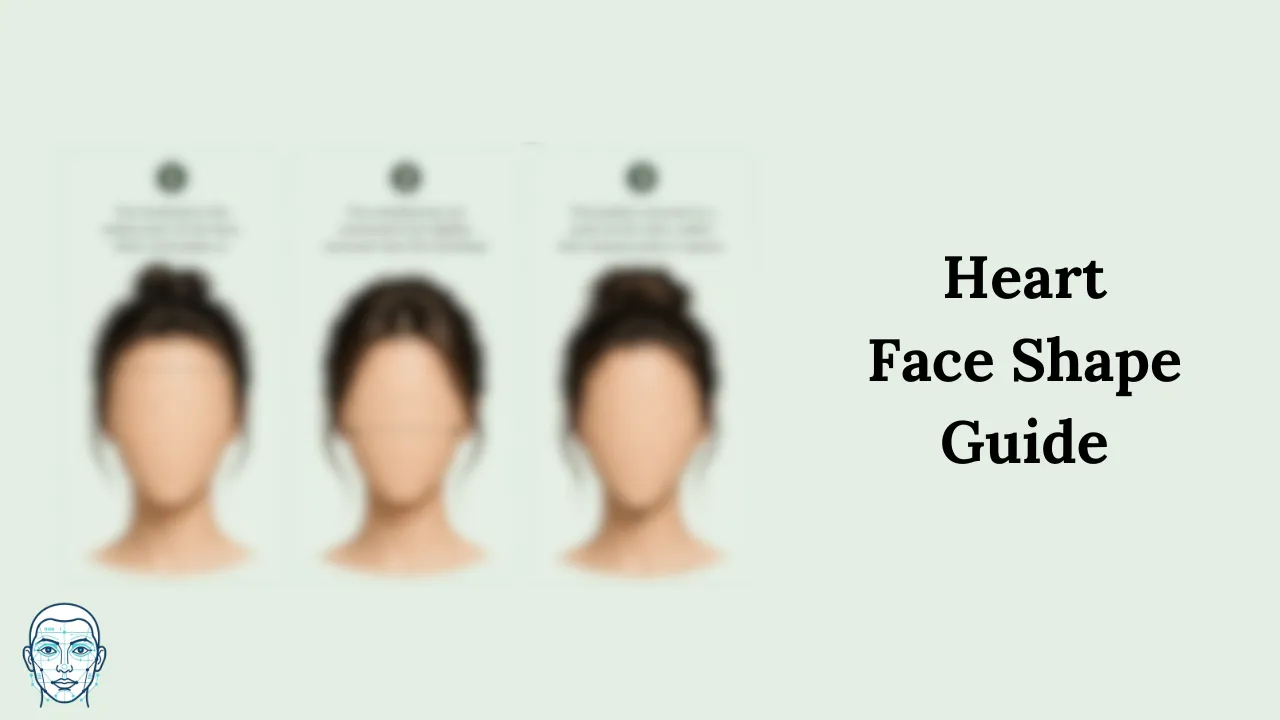
A heart-shaped face is one of the more distinctive shapes to spot — a wider forehead that tapers down to a narrower, often pointed chin, sometimes with a widow’s peak sharpening the silhouette further. It’s also one of the shapes people misidentify most often, usually because they’re looking for a cartoonish, perfectly symmetrical heart outline instead of the more subtle real-world version. This guide covers exactly what defines the shape, how to confirm it, and the styling logic that balances it best.
What Defines a Heart Face Shape
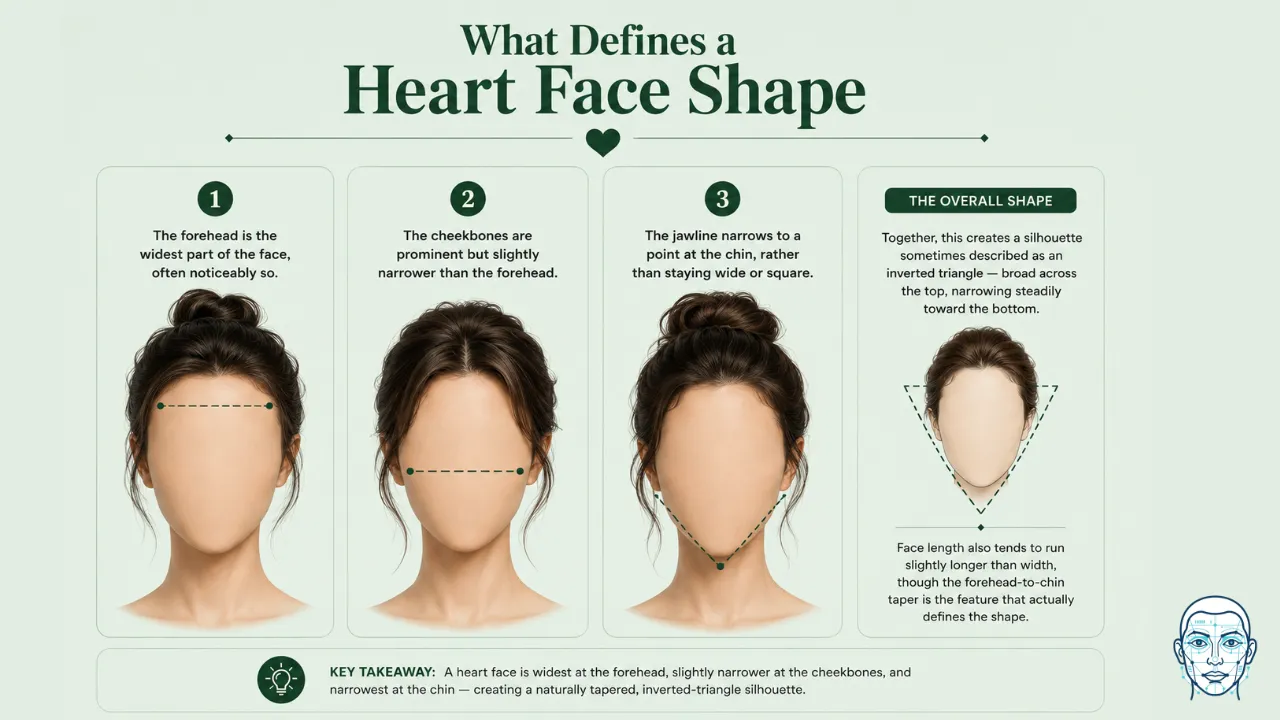
A heart face has three consistent identifying features:
- The forehead is the widest part of the face, often noticeably so
- The cheekbones are prominent but slightly narrower than the forehead
- The jawline narrows to a point at the chin, rather than staying wide or square
Together, this creates a silhouette sometimes described as an inverted triangle — broad across the top, narrowing steadily toward the bottom. Face length also tends to run slightly longer than width, though the forehead-to-chin taper is the feature that actually defines the shape.
How to Identify a Heart Face
Pull your hair back and check straight into a mirror, or measure directly for a more objective answer:
- Measure your forehead width, your cheekbone width, and your jawline width
- If your forehead is the widest of the three, and your jawline is the narrowest, that’s a strong indicator of a heart face
A visual mirror check can work too, but it’s genuinely easy to second-guess yourself here — a photo-based face shape tool settles it with an objective answer rather than a guess.
Does a Heart Face Require a Widow’s Peak? (No — Here’s the Real Answer)
This is worth addressing directly, since it’s a genuinely common point of confusion: a widow’s peak is not required for a heart-shaped face. A widow’s peak — that V-shaped dip in the hairline — is a common accompanying trait that sharpens the heart-like silhouette further, but plenty of people have the full set of heart-face proportions (wide forehead, narrow chin) with a completely straight hairline instead. What actually defines the shape is the forehead-to-chin taper, not the hairline pattern layered on top of it.
Put simply: most people with a strong widow’s peak do have heart-shaped proportions, but not everyone with a heart-shaped face has a widow’s peak. If you’ve been unsure whether you “count” because your hairline is straight, that alone doesn’t rule the shape out.
Heart vs. Oval vs. Diamond: The Mix-Ups to Watch For
Heart gets confused with two other shapes most often, and each comes down to a specific difference:
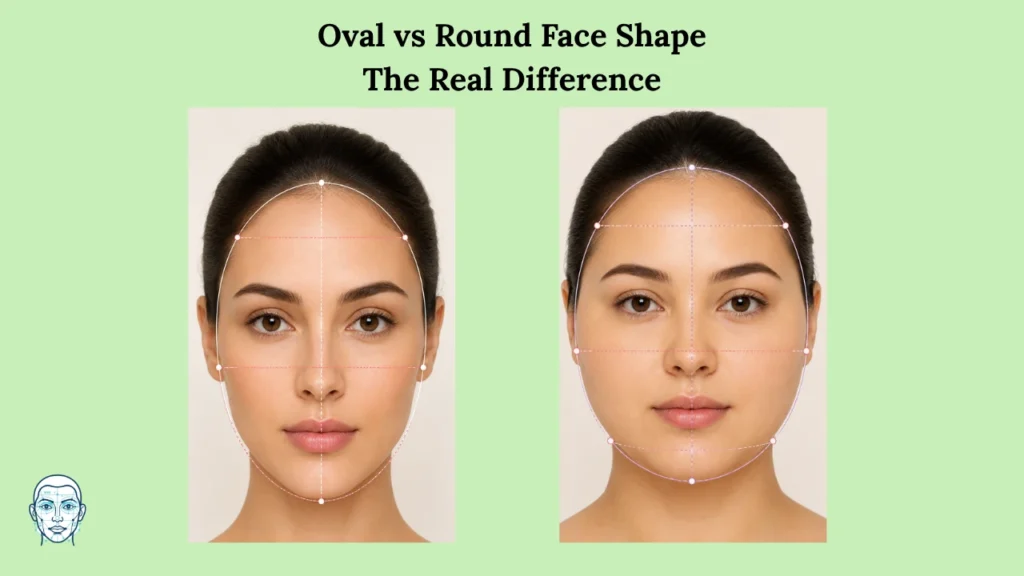
- Heart vs. oval — an oval face shape tapers gently at both the forehead and the chin, keeping the whole face’s proportions fairly even. A heart face is clearly, noticeably wider at the top; the upper half visibly dominates rather than tapering symmetrically.
- Heart vs. diamond — a diamond face has a narrow forehead and a narrow jaw, with the cheekbones as the standout widest point. A heart face specifically has a wide forehead — that’s the key difference, since diamond narrows at both ends while heart is wide at exactly one.
If you’re stuck between two of these, comparing your actual forehead width against your jaw width resolves it faster than trying to judge the whole face shape at once.
The Styling Goal Behind Every Recommendation Here
Here’s the one idea to keep in mind throughout this guide: the goal isn’t to change your proportions, it’s to create visual balance between a wider top half and a narrower bottom half. Nearly every recommendation below works by adding a bit of visual weight near the jaw and chin, or by softening how wide the forehead reads — not by disguising the shape, just by bringing the two halves into better visual harmony.
Best Hairstyles for a Heart Face
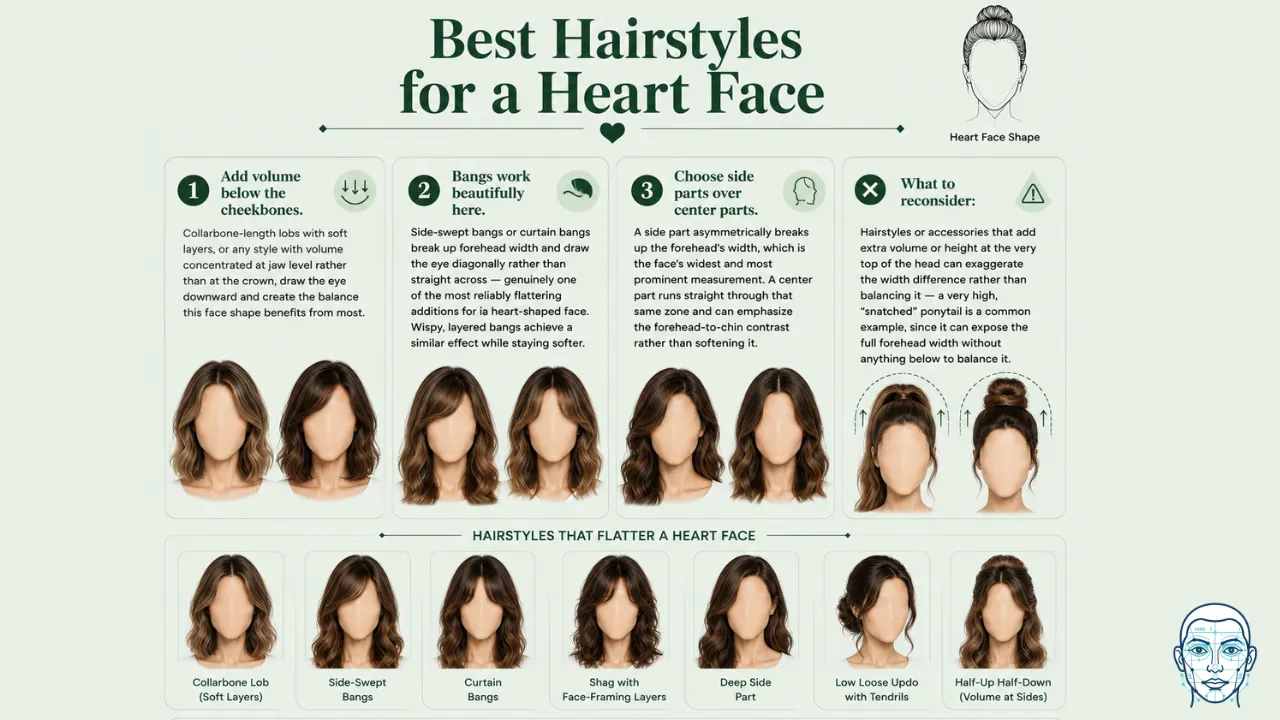
Add volume below the cheekbones. This is the single most effective technique for this shape — collarbone-length lobs with soft layers, or any style with volume concentrated at jaw level rather than at the crown, draw the eye downward and create the balance this face shape benefits from most.
Bangs work beautifully here. Side-swept bangs or curtain bangs break up forehead width and draw the eye diagonally rather than straight across — genuinely one of the most reliably flattering additions for a heart-shaped face. Wispy, layered bangs achieve a similar effect while staying softer.
Choose side parts over center parts. A side part asymmetrically breaks up the forehead’s width, which is the face’s widest and most prominent measurement. A center part runs straight through that same zone and can emphasize the forehead-to-chin contrast rather than softening it — one of the simplest, lowest-effort adjustments available for this shape.
What to reconsider: hairstyles or accessories that add extra volume or height at the very top of the head can exaggerate the width difference rather than balancing it — a very high, “snatched” ponytail is a common example, since it can expose the full forehead width without anything below to balance it.
Best Glasses for a Heart Face
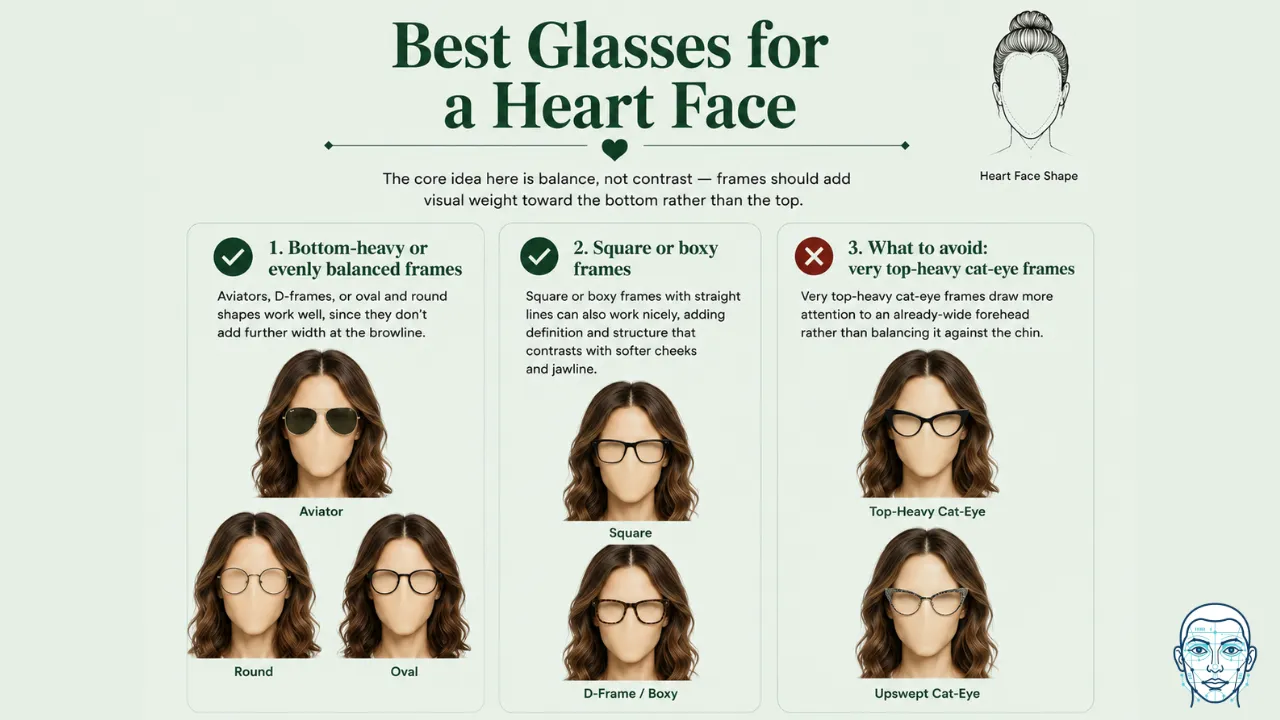
The core idea here is balance, not contrast — frames should add visual weight toward the bottom rather than the top.
- Bottom-heavy or evenly balanced frames — aviators, D-frames, or oval and round shapes — work well, since they don’t add further width at the browline
- Square or boxy frames with straight lines can also work nicely, adding definition and structure that contrasts with softer cheeks and jawline
- What to avoid: very top-heavy cat-eye frames, which draw more attention to an already-wide forehead rather than balancing it against the chin
Makeup Tips for a Heart Face
- A soft, lifted cat-eye liner elongates the eyes without adding extra visual weight up top
- Aim for a softly rounded brow arch rather than a sharp, high peak — a very angular brow can over-emphasize forehead height, working against the balance you’re going for
- Bold lips or definition at the jawline helps draw the eye downward, complementing the same “add weight below” principle used in hairstyling
Accessories: Adding Weight Where It Helps Most
The same balancing principle extends naturally to jewelry:
- Teardrop earrings and pieces that add width at the jaw work well, since they visually reinforce the lower half of the face
- Shorter necklaces tend to suit this shape better than long, straight pendant styles, since they sit closer to the width you’re trying to balance toward
A Quick Note for Men with a Heart-Shaped Face
The same balancing principle applies, adjusted for typical men’s styling choices:
- Shorter sides with textured length on top avoid adding extra width at the forehead while still giving some styling flexibility
- A fuller beard, particularly with some width at the jawline, adds exactly the kind of visual weight below that this face shape benefits from — it’s one of the most effective tools available for men with this shape specifically
- Avoid styles swept straight back with no fringe, since fully exposing the forehead removes the one area (bangs or a fringe) doing the most balancing work
What to Ask Your Stylist or Optician
Bringing specific language into an appointment tends to get a more accurate result than a general description. A few phrases worth using directly:
- At a salon: “I have a heart-shaped face with a wider forehead, so I’d like volume concentrated below my cheekbones, plus a side part rather than a center part.”
- For bangs specifically: “I’d like side-swept or curtain bangs that soften my forehead width without a hard, straight-across line.”
- For glasses: “I have a heart-shaped face, so I’m looking for something bottom-heavy or balanced — aviators or oval frames — and I’d like to avoid anything too dramatic at the brow line.”
A Brief, Honest Note on Weight and Face Shape
Because the chin in a heart-shaped face is already narrow, meaningful weight loss can sometimes make the shape read as more sharply angular, since some of the cheek fullness that softened the overall silhouette is reduced. This isn’t something to be concerned about — it’s simply a factual note on how this particular shape can shift in appearance, and if it happens, softer, wavier hairstyles tend to counter the added angularity nicely.
Quick Recap
A heart face has a wide forehead as its widest point, tapering down to a narrower, often pointed chin — with or without a widow’s peak, which is a common trait but never a requirement. Every recommendation in this guide comes back to one idea: add visual weight near the jaw and soften how wide the forehead reads, bringing the two halves of the face into balance rather than trying to disguise the shape itself.
Frequently Asked Questions
What is the main characteristic of a heart face shape?
A forehead that’s the widest part of the face, tapering down to a narrower, often pointed chin — sometimes described as an inverted triangle silhouette.
Do I need a widow’s peak to have a heart-shaped face?
No — this is a common misconception. A widow’s peak is a frequent accompanying trait that sharpens the heart-like appearance, but it isn’t required. What actually defines the shape is the forehead-to-chin taper, not the hairline pattern.
What’s the difference between a heart and an oval face?
An oval face tapers gently and evenly at both the forehead and the chin. A heart face is clearly, noticeably wider at the top — the forehead visibly dominates rather than the whole face narrowing symmetrically.
What’s the difference between a heart and a diamond face?
A diamond face has a narrow forehead and a narrow jaw, with the cheekbones as the widest point. A heart face specifically has a wide forehead as its widest point, which is the key distinguishing feature between the two.
What hairstyles work best for a heart-shaped face?
Styles with volume concentrated below the cheekbones — like a collarbone-length lob with soft layers — paired with side-swept or curtain bangs and a side part rather than a center part.
What glasses should I avoid with a heart-shaped face?
Very top-heavy cat-eye frames tend to draw more attention to an already-wide forehead. Bottom-heavy or balanced frames — aviators, D-frames, oval, or round shapes — are generally more flattering.
How do I know for sure if I have a heart-shaped face?
Measure your forehead, cheekbone, and jawline width. If your forehead is clearly the widest measurement and your jawline is the narrowest, that’s a strong indicator. A photo-based face shape tool can confirm it more precisely than a mirror check alone.
Can weight changes affect a heart-shaped face?
Yes, to some degree. Since the chin in this shape is already narrow, significant weight loss can reduce cheek fullness and make the face read as more sharply angular. Softer, wavier hairstyles can help counter that added angularity if it happens.
See Your Face Shape
Upload photo and get your face shape — analyzed on your device, nothing ever uploaded anywhere.
Explore all tools →