A round face is one of the easiest shapes to spot once you know what to look for — soft curves, full cheeks, and no sharp angles anywhere along the jaw. It’s also one of the shapes with the clearest styling logic behind it: nearly every recommendation in this guide comes back to one idea, adding length and a bit of angular contrast. Once you understand that single principle, you can judge almost any hairstyle, frame, or accessory yourself.
What Defines a Round Face Shape
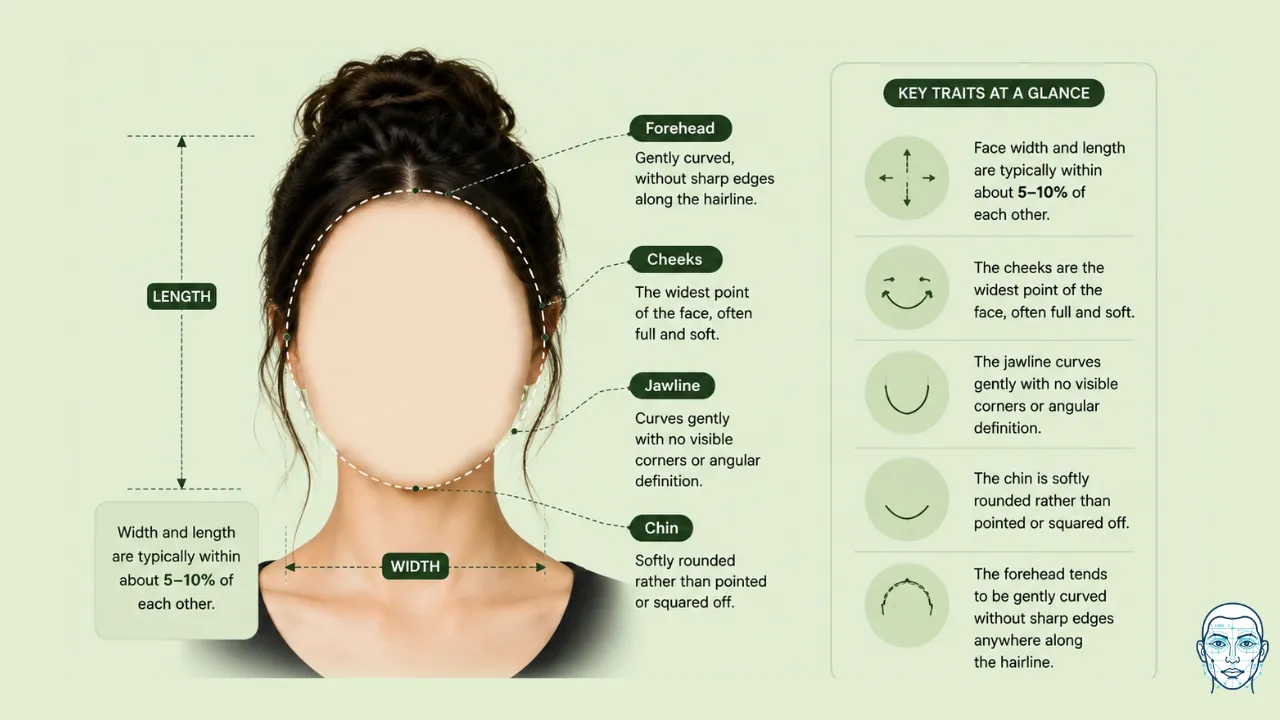
A round face has width and length that are close to equal, giving it a circular overall impression rather than an elongated one. A few traits consistently show up together:
- Face width and length are typically within about 5–10% of each other
- The cheeks are the widest point of the face, often full and soft
- The jawline curves gently with no visible corners or angular definition
- The chin is softly rounded rather than pointed or squared off
- The forehead tends to be gently curved as well, without sharp edges anywhere along the hairline
Unlike a square face — which shares the similar width-to-length ratio but has a defined, angular jaw — a round face has softness everywhere. Every transition from forehead to cheek to jaw happens smoothly, without a single hard corner along the outline.
How to Identify a Round Face
Pull your hair back completely and look straight into a mirror. A few quick checks:
- Does your face look about as wide as it is long, rather than clearly longer?
- Are your cheeks the fullest, widest part of your face?
- Does your jawline curve smoothly into your chin, without any angular corner?
If you answered yes to all three, a round face shape is likely. For more certainty, comparing your actual forehead, cheekbone, and jaw measurements — or using a photo-based face shape tool — settles it with real numbers instead of a visual guess.
Round vs. Oval vs. Square: The Mix-Ups to Watch For
Round gets confused with two other shapes most often, and each comes down to one specific difference:
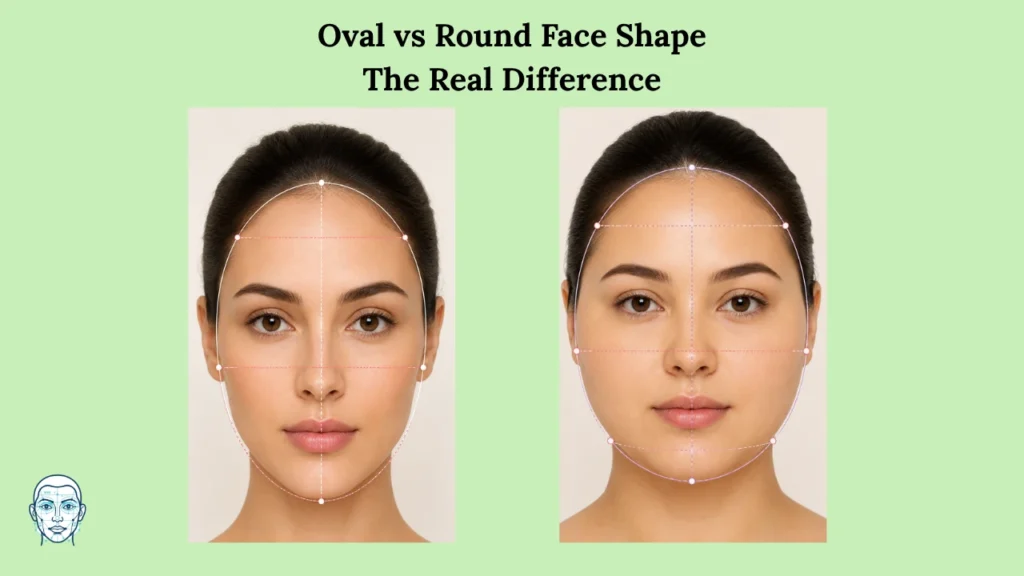
- Round vs. oval — this is about length. An oval face shape is clearly longer than it is wide; a round face has length and width that are close to equal.
- Round vs. square — this is about the jaw. Both shapes can have a similar width-to-length ratio, but a square jaw has visible angular corners, while a round jaw curves smoothly with no corners at all.
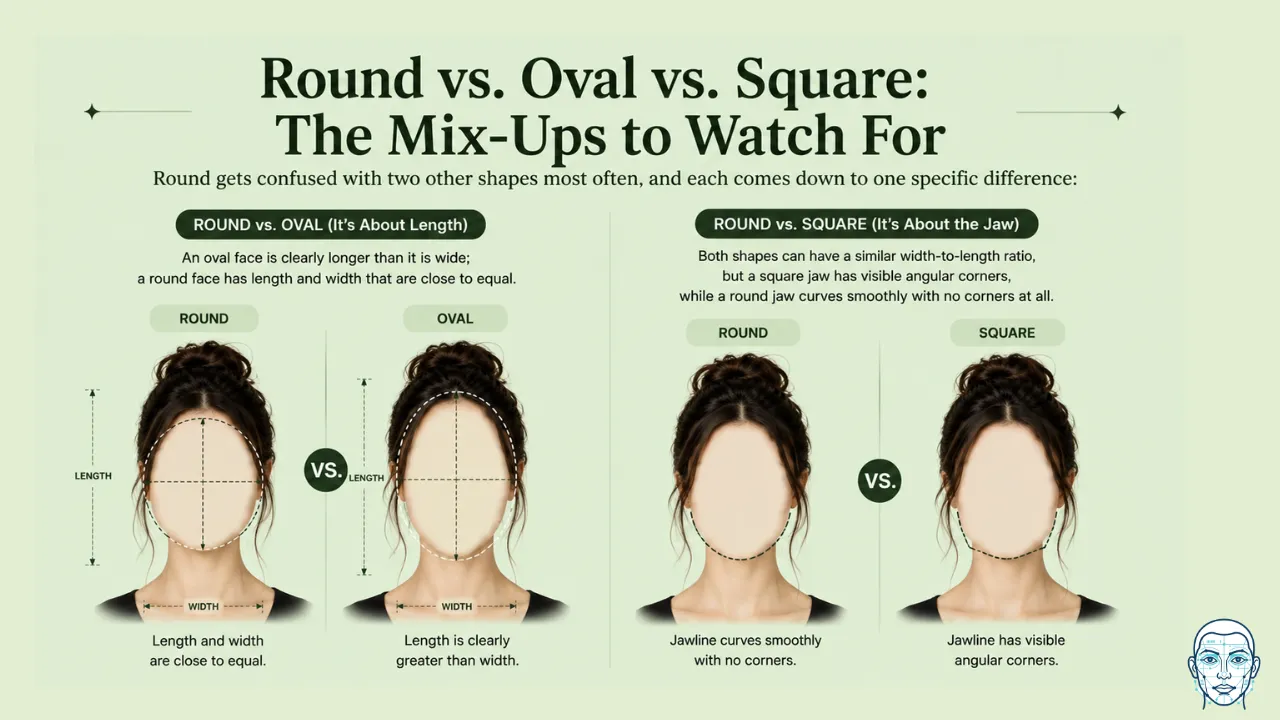
If you’re stuck between two of these, checking that one specific difference is faster than trying to compare your whole face at once.
The One Principle Behind Every Styling Recommendation Here
Picture your face as a circle. Nearly every piece of advice in this guide is about strategically adding lines, angles, and vertical length to break up that circular impression — not to change your face, but to introduce a bit of visual contrast against its natural softness. Keep that single idea in mind, and you can evaluate almost any hairstyle, frame, or accessory choice on your own.
Makeup Tips for a Round Face
- Contour along the sides of the face, particularly beneath the cheekbones, to add subtle definition
- Blush placed slightly higher, toward the temples, rather than directly on the apples of the cheeks, avoids adding more fullness to the widest part of the face
- A slightly elongated brow shape can add a touch of vertical line without needing to change anything else about your look
Accessories and Necklines: An Often-Overlooked Extension
The same “add angles and length” principle applies well beyond hair and glasses, and it’s worth extending it here too:
- Angular earrings — geometric shapes, rectangular drops, or linear designs — add definition that contrasts with the face’s soft curves. Large circular hoops tend to do the opposite, mirroring and slightly amplifying the roundness.
- Long pendant necklaces create a strong vertical line that draws the eye downward, which works better here than a short choker-style necklace sitting right at the widest part of the face.
- V-neck and scoop-neck tops create a downward-pointing shape that helps elongate the overall silhouette; wide boat necks add horizontal width instead, working against the same goal.
A Quick Myth to Clear Up
It’s worth saying directly: a round face shape comes from bone structure and natural cheek fullness — it isn’t simply a matter of body weight. Plenty of people at a wide range of body types have naturally round facial proportions, and plenty of people with fuller cheeks have entirely different underlying face shapes. Treating “round” as a body-weight descriptor rather than a genuine structural face shape is inaccurate, and honestly, it’s a framing worth leaving behind.
Round Face Shape for Men: Beards and Haircuts
The same “add length and angles” principle applies just as directly to men’s styling, with a couple of specific additions worth knowing:
Beard shape matters more than usual here. A beard with sharper definition along the jawline — a boxed beard, for example — adds the angular structure a round face doesn’t have naturally, while a very rounded, uniformly short beard can echo the face’s existing softness instead of balancing it.
Haircuts follow the same height-over-width logic. A textured crop or a quiff with volume up top elongates the face the same way crown volume does for longer hairstyles. Very short, uniform buzz cuts are worth approaching carefully, since removing all volume can occasionally emphasize roundness rather than reducing it — a little length and texture on top tends to work better than going as short as possible.
What to Ask Your Stylist or Optician
Bringing specific language into an appointment gets a better result than describing your face shape vaguely. A few phrases worth using directly:
- At a salon: “I have a round face, so I’d like layers with height at the crown rather than volume at the sides — and I’d rather avoid a blunt bob that ends right at my cheeks.”
- For glasses: “I have a round face, so I’m looking for something angular — rectangle or cat-eye frames specifically, and nothing round or very small.”
- For a beard (if applicable): “I’d like a beard shape with a defined jawline rather than something uniformly rounded, to add a bit more structure.”
Quick Recap
A round face has width and length that are close to equal, full cheeks as the widest point, and a soft, curved jawline with no sharp angles anywhere. Nearly everything that flatters this shape comes down to one idea — add length and a bit of angular contrast — whether that’s through a hairstyle, a pair of glasses, an earring shape, or even a neckline. Keep that single principle in mind, and you’ll be able to judge new styles confidently on your own.
Frequently Asked Questions
What is the main characteristic of a round face shape?
Width and length that are close to equal, combined with full cheeks as the widest point and a soft, curved jawline with no angular definition — the overall impression reads as circular rather than elongated.
How do I know if I have a round face shape?
Check whether your face is about as wide as it is long, whether your cheeks are the fullest part of your face, and whether your jawline curves smoothly with no visible corners. A tape measurement or a photo-based face shape tool can confirm it with more certainty.
What’s the difference between a round and an oval face?
Length. An oval face is clearly longer than it is wide, while a round face has width and length that are close to equal.
What’s the difference between a round and a square face?
The jawline. Both shapes can share a similar width-to-length ratio, but a square face has a defined, angular jaw, while a round face’s jawline curves smoothly with no corners.
What hairstyles should I avoid with a round face?
A blunt, chin-length bob is the most commonly flagged style to reconsider, since it ends right at the face’s widest point and draws attention to roundness rather than balancing it. A full, blunt, straight-across fringe can have a similar effect.
Can short hair work for a round face?
Yes — a textured pixie cut with height on top and sleeker sides can look sharp and flattering. The key is adding height and structure rather than avoiding short hair altogether.
Does a round face shape mean someone is overweight?
No. A round face shape comes from bone structure and natural cheek fullness, not body weight. People across a wide range of body types can have a naturally round face shape, and cheek fullness alone doesn’t determine someone’s actual underlying face shape.
What glasses should I avoid with a round face?
Small, round frames tend to echo the face’s natural curves rather than balancing them. Rectangle, square, cat-eye, and geometric frames are generally more flattering choices.
Explore Your Face Shape
Upload one photo — analyzed on your device, nothing ever uploaded anywhere.
Analyze Your Face →