A diamond face shape is defined by one striking feature: cheekbones that are clearly the widest part of the face, with both the forehead and jaw narrowing noticeably on either side. It’s also, by a wide margin, the most commonly misidentified face shape — the same dramatic cheekbones that define it can look, at a quick glance, like the widest point of an oval or heart-shaped face too. This guide covers exactly how to tell the difference, plus the styling logic that works best for this genuinely distinctive shape.
What Defines a Diamond Face Shape
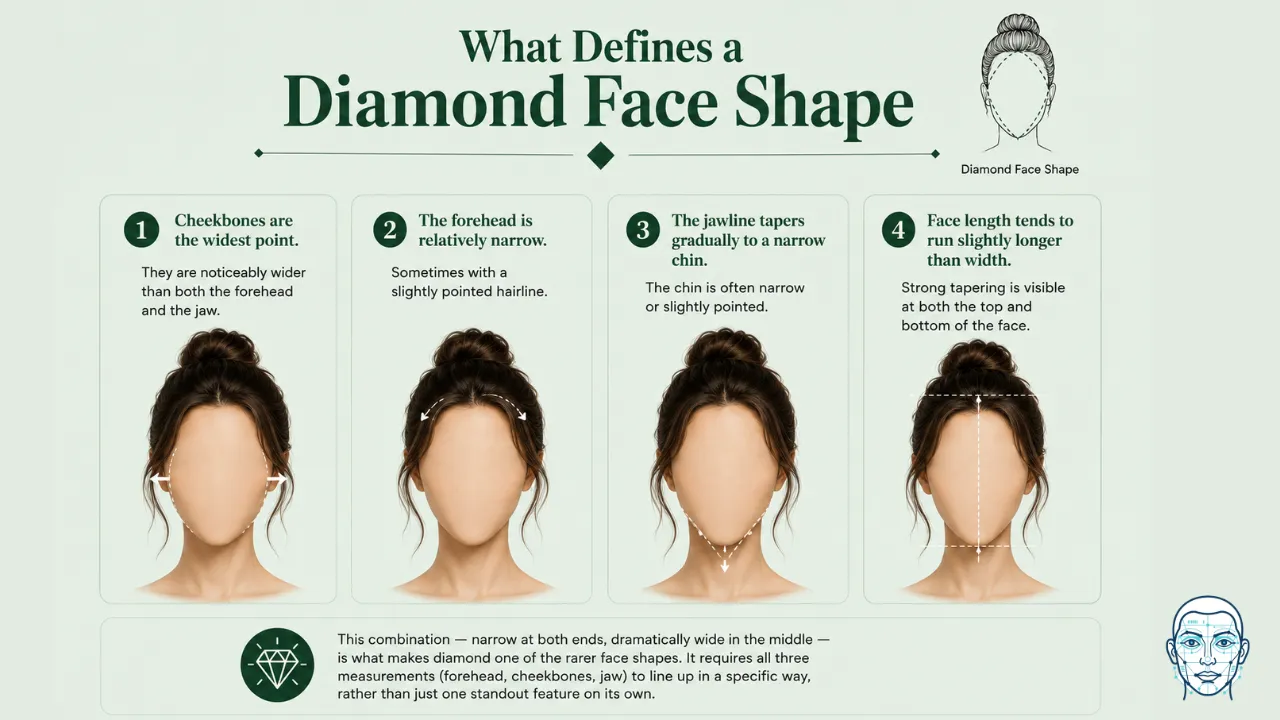
A diamond face has four consistent identifying traits:
- The cheekbones are the widest point of the face — noticeably wider than both the forehead and the jaw
- The forehead is relatively narrow, sometimes with a slightly pointed hairline
- The jawline tapers gradually to a narrow, sometimes pointed chin
- Face length tends to run slightly longer than width, with strong tapering visible at both the top and bottom of the face
This combination — narrow at both ends, dramatically wide in the middle — is what makes diamond one of the rarer face shapes. It requires all three measurements (forehead, cheekbones, jaw) to line up in a specific way, rather than just one standout feature on its own.
How to Identify a Diamond Face
Pull your hair back completely and look straight into a mirror, or measure directly for a more reliable answer:
- Measure your forehead width, cheekbone width, and jawline width
- If your cheekbones are dramatically wider than both your forehead and your jaw, that’s a strong indicator of a diamond face
This is genuinely one of the trickier shapes to self-identify through a mirror check alone, since the defining feature (wide cheekbones) is shared with other shapes too — a photo-based face shape tool is particularly useful here, precisely because it compares all three measurements at once rather than relying on a single visual impression.
Why Diamond Is the Most Commonly Misidentified Face Shape
This is worth addressing directly, since it’s the reason so many people end up here uncertain rather than confident. Wide, prominent cheekbones are the headline feature of a diamond face — but they’re also present, to a lesser degree, in oval and heart-shaped faces. The difference isn’t just “do I have noticeable cheekbones,” it’s specifically whether both the forehead and jaw are meaningfully narrower than those cheekbones. Getting this comparison right is what actually separates diamond from its two most common mix-ups, covered next.
Diamond vs. Heart vs. Oval: The Mix-Ups to Watch For
- Diamond vs. heart — both shapes share a narrow, often pointed chin and prominent cheekbones. The deciding factor is the forehead: heart has a wide forehead as its widest point, while diamond has a narrow forehead, with the cheekbones taking over as the widest point instead.
- Diamond vs. oval — an oval face has softly tapered curves throughout, with cheekbones as a gentle, unremarkable widest point. A diamond face has dramatically pronounced cheekbones with sharp, noticeable narrowing at both the forehead and chin — the contrast between narrow and wide is far more pronounced than in an oval face.
If you’re stuck between two of these, comparing your forehead width specifically against your cheekbone width resolves the diamond-vs-heart question fastest, while comparing how dramatic your cheekbone prominence actually is resolves the diamond-vs-oval question.
The Styling Principle Behind Every Recommendation Here
Here’s the one idea to keep in mind throughout this guide: the goal is to add visual width at the forehead and chin, softening the contrast with your cheekbones rather than trying to hide them. Diamond cheekbones are widely considered a striking, desirable feature — contouring trends and cosmetic procedures often try to recreate this exact prominence artificially. The styling approach here isn’t about disguising your bone structure; it’s about creating balance around a feature that’s already working in your favor.
Best Hairstyles for a Diamond Face
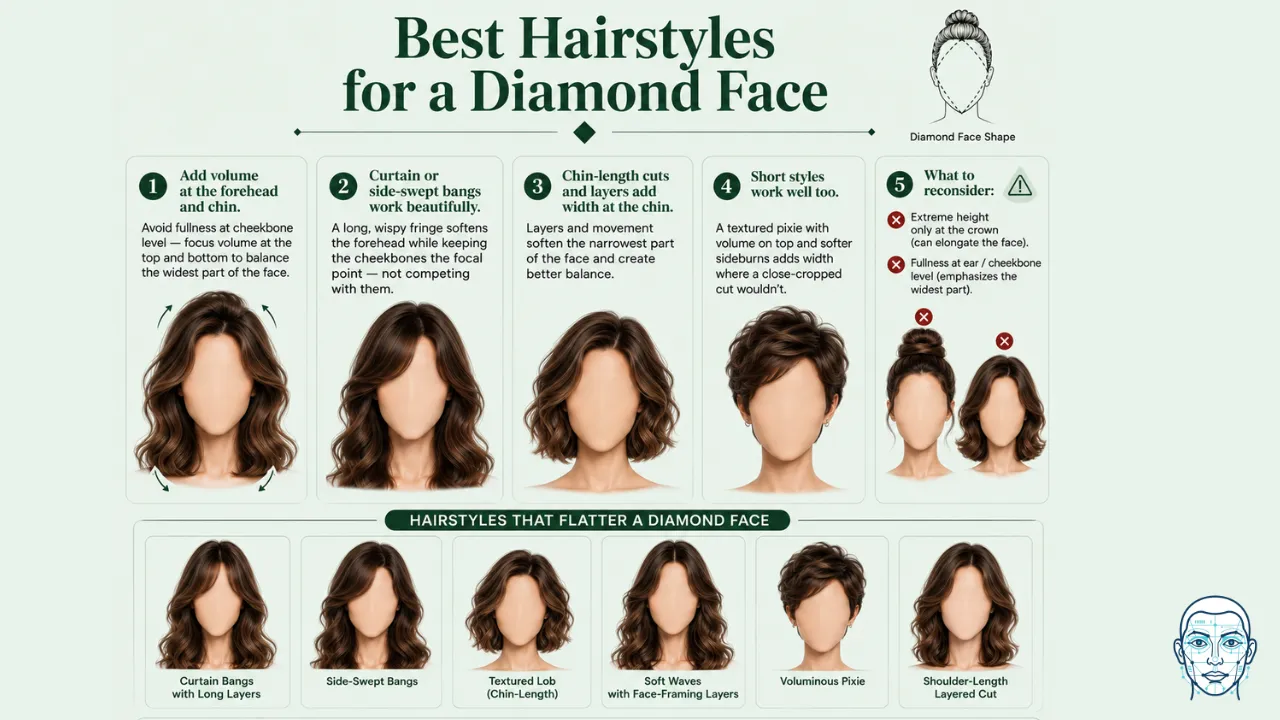
Add volume at the forehead and chin, not at cheekbone level. This is the core technique — any hairstyle with fullness concentrated around ear or cheekbone height will emphasize the widest part of the face rather than balancing it, which works against the goal here.
Curtain or side-swept bangs are especially effective. A long, wispy fringe swept to the side softens the forehead without creating a hard, horizontal line, while still letting your cheekbones remain the visual focal point rather than competing with them.
Chin-length cuts and layers with movement add width where the face is naturally narrowest. If you prefer long hair, incorporating layers and movement matters more here than for most other face shapes — one-length, flat hair tends to emphasize the narrowness at both the forehead and chin rather than softening it.
Short styles work well too. A textured pixie with some volume on top and softer sideburns reads as chic rather than severe, adding width exactly where a very close-cropped cut wouldn’t.
What to reconsider: extreme height concentrated only at the very crown can elongate the face further, which can look unbalanced on a face that’s often already slightly longer than it is wide. Styles that add fullness specifically at ear level — flipping outward right at cheekbone height — work against the balancing goal for the same reason mentioned above.
Best Glasses for a Diamond Face
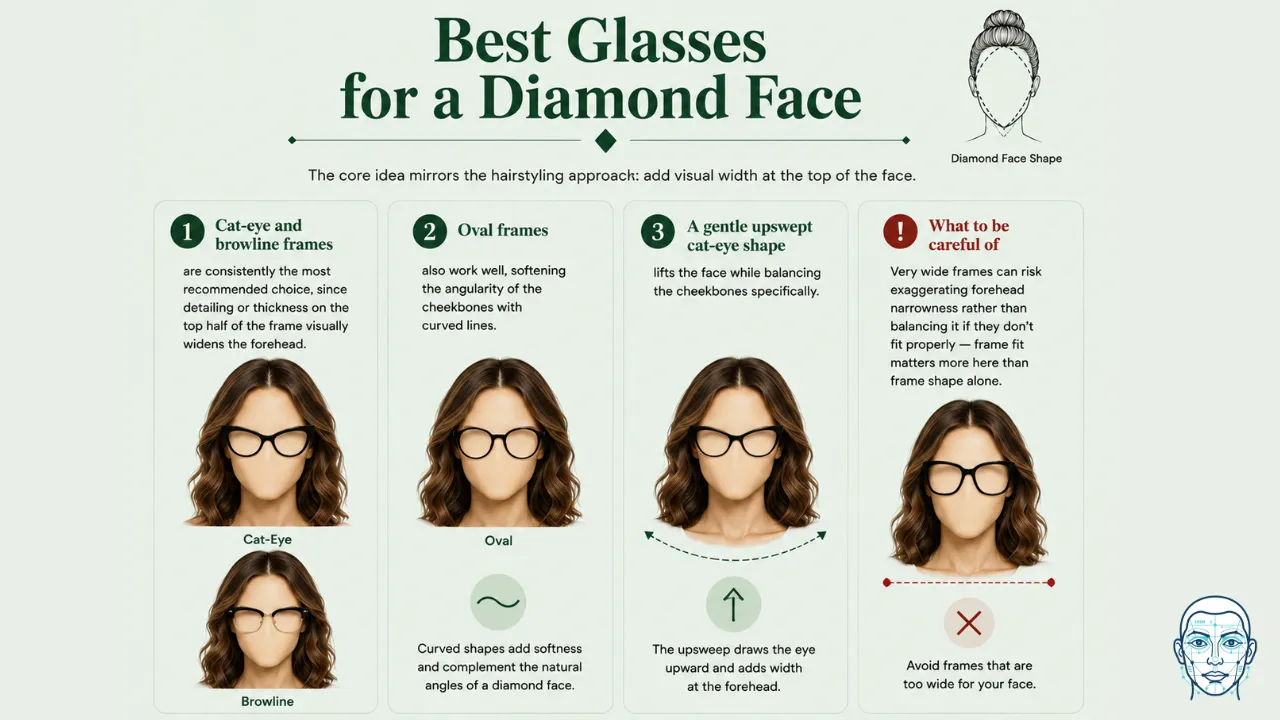
The core idea mirrors the hairstyling approach: add visual width at the top of the face.
- Cat-eye and browline frames are consistently the most recommended choice, since detailing or thickness on the top half of the frame visually widens the forehead
- Oval frames also work well, softening the angularity of the cheekbones with curved lines
- A gentle upswept cat-eye shape lifts the face while balancing the cheekbones specifically
- What to be careful of: very wide frames can risk exaggerating forehead narrowness rather than balancing it if they don’t fit properly — frame fit matters more here than frame shape alone
Makeup Tips for a Diamond Face
- Highlight the center of the forehead and the center of the chin — this is one of the most effective techniques for this shape specifically, since it visually brings both narrow areas forward, creating the illusion of added width
- Contour with a light hand just beneath the cheekbones, blended carefully — the goal is softening, not reshaping a feature that’s already a strength
- A gently curved or arched brow softens the overall angularity and can help the forehead read as slightly wider than it measures
Accessories: Balancing Top and Bottom
The same principle extends naturally to jewelry and necklines:
- Teardrop or chandelier earrings provide bottom-heavy balance near the jaw and chin; very narrow, long drop earrings tend to emphasize the diamond outline rather than softening it
- Long pendant necklaces and V-necklines draw the eye downward toward the narrow chin, adding to the overall sense of balance
- Scoop or cowl necklines work well for the same reason, softening the transition toward the narrower lower face
A Brief, Honest Note on Weight and Face Shape
The underlying bone structure that creates a diamond face shape stays stable across typical weight ranges, so for most people, the fundamental proportions don’t shift into a different category. That said, meaningful weight gain can soften how prominent the cheekbones appear, since added facial fullness reduces the contrast between the cheekbones and the rest of the face. This isn’t something to be concerned about — it’s simply a factual note on how the shape’s most defining feature can read slightly differently depending on facial fullness, while the basic structure itself remains the same.
Quick Recap
A diamond face has cheekbones as its clearly widest point, with both the forehead and jaw narrowing noticeably on either side — a genuinely striking, relatively rare combination, and one that’s frequently confused with heart or oval at a glance. Nearly every styling recommendation here comes back to one idea: add visual width at the forehead and chin, letting your cheekbones stay the focal point they’re already built to be.
Frequently Asked Questions
What is the main characteristic of a diamond face shape?
Cheekbones that are clearly the widest part of the face, with both the forehead and jawline noticeably narrower on either side — creating a distinct, angular silhouette that’s wider in the middle than at either end.
Is diamond really the rarest face shape?
It’s frequently described as one of the rarer face shapes, since it requires all three measurements — forehead, cheekbones, and jaw — to align in a specific narrow-wide-narrow pattern, rather than just one standout feature.
What’s the difference between a diamond and a heart-shaped face?
The forehead. A heart-shaped face has a wide forehead as its widest point, while a diamond face has a narrow forehead, with the cheekbones taking over as the widest point instead. Both shapes share a narrow, often pointed chin.
What’s the difference between a diamond and an oval face?
The degree of contrast. An oval face has softly tapered curves with cheekbones as a gentle, unremarkable widest point. A diamond face has dramatically pronounced cheekbones with sharp, noticeable narrowing at both the forehead and chin.
Why is diamond considered the most commonly misidentified face shape?
Because its defining feature — prominent cheekbones — is also present to a lesser degree in oval and heart-shaped faces. The real distinguishing factor is whether both the forehead and jaw are meaningfully narrower than the cheekbones, which is easy to miss with just a quick mirror glance.
What hairstyles work best for a diamond face?
Styles that add volume at the forehead and chin — curtain or side-swept bangs, chin-length cuts, and layers with movement — while avoiding extra fullness right at cheekbone or ear level, which emphasizes the face’s widest point rather than balancing it.
What glasses should I avoid with a diamond face?
Very wide frames can risk exaggerating forehead narrowness if they don’t fit properly. Cat-eye, browline, and oval frames are generally the most flattering, since they add visual width at the top of the face.
Can weight changes affect a diamond face shape?
The underlying bone structure stays stable across typical weight ranges, so the basic shape classification doesn’t usually change. Meaningful weight gain can soften how prominent the cheekbones appear, since added facial fullness reduces the contrast with the rest of the face.
Analyze Your Face Shape
Upload photo and get your face shape — analyzed on your device, nothing ever uploaded anywhere.
Explore all tools →