If you’ve ever read a hairstyle or glasses guide and seen the phrase “works for almost everyone” attached to a specific recommendation, there’s a good chance that recommendation was written with an oval face in mind. Oval is consistently described as the most balanced, most versatile face shape to style — but “versatile” doesn’t mean “no features worth understanding.” This guide covers exactly what defines an oval face, how to check if you have one, and what actually suits it best.
What Defines an Oval Face Shape
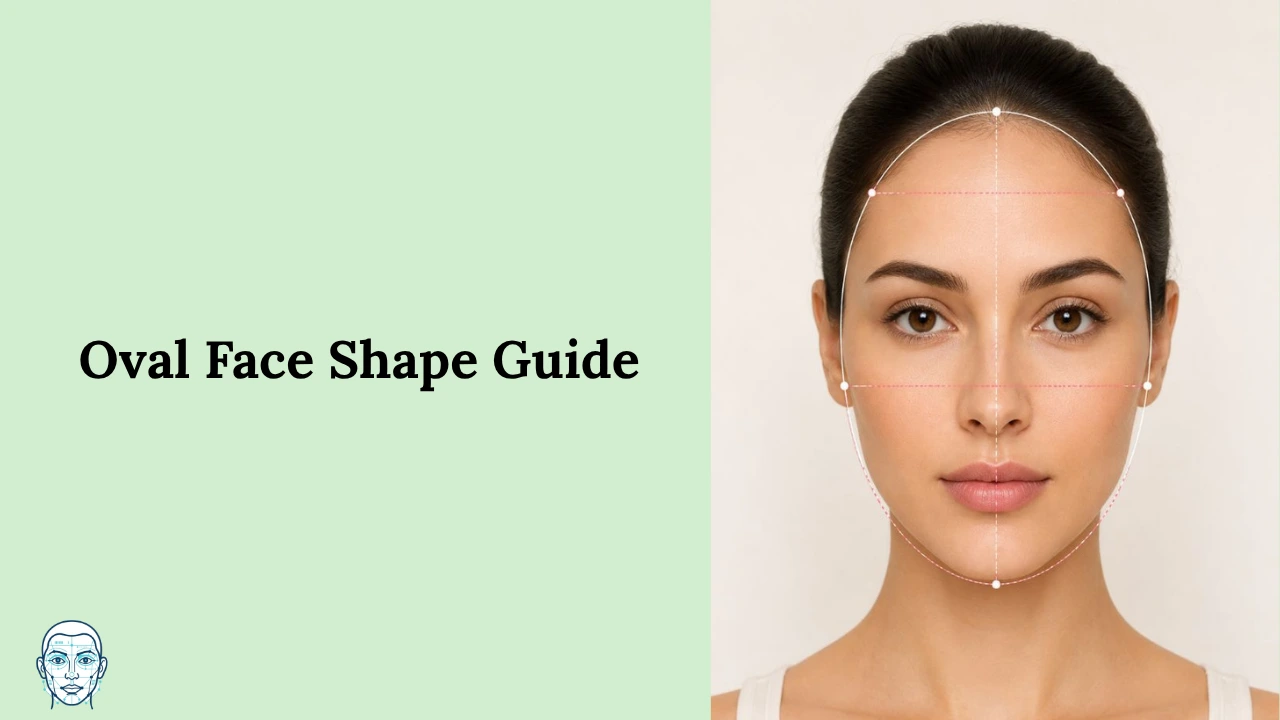
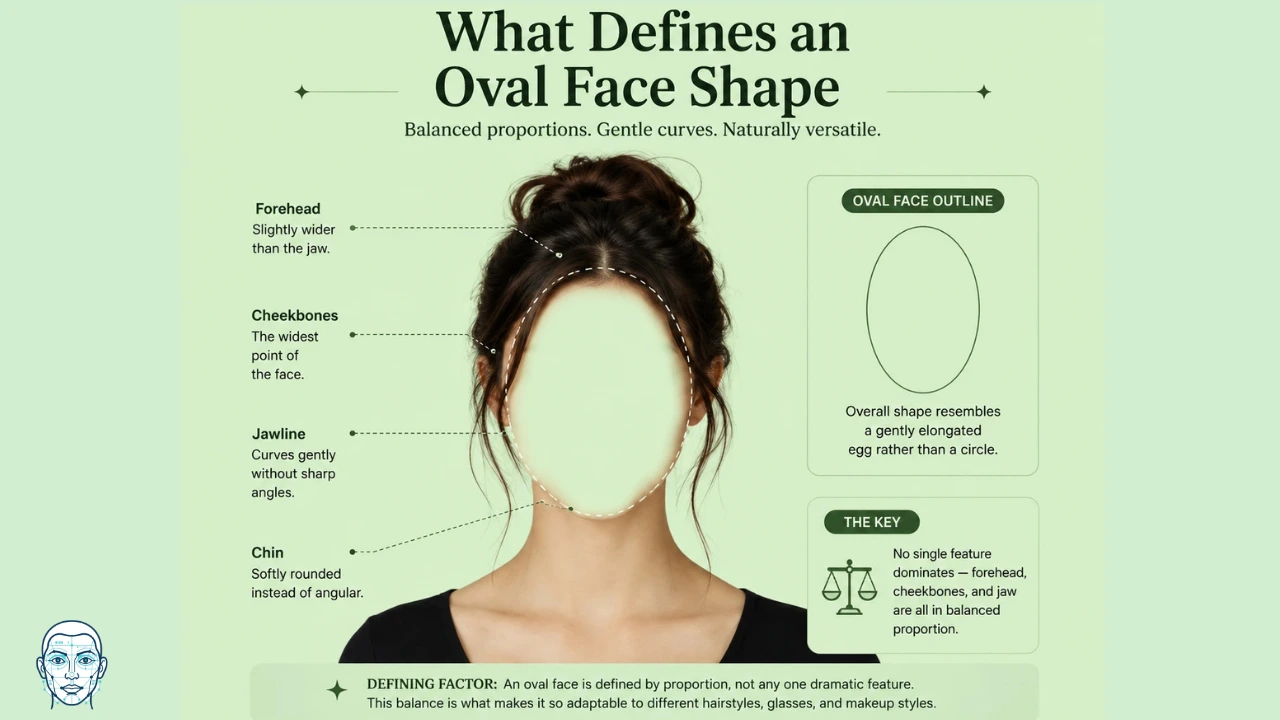
An oval face is longer than it is wide — roughly one and a half times the width — with a handful of proportions that consistently show up together:
- The cheekbones are the widest point of the face
- The forehead is slightly wider than the jaw
- The jawline curves gently, without sharp angles, down to a softly rounded chin
- The overall outline resembles a gently elongated egg shape rather than a circle
What actually defines this shape is proportion, not any single dramatic feature. No part of the face — forehead, cheekbones, or jaw — dominates the others, which is the real reason oval ends up being so flexible to style: there’s no imbalance that a haircut, frame shape, or makeup technique needs to correct.
How to Identify an Oval Face
Confirming this at home takes less than a minute. Pull your hair back completely, look straight into a mirror, and check for these signs:
- Your face reads as noticeably longer than it is wide, without looking stretched
- The sides curve gently rather than forming any sharp angle
- Your cheekbones sit as the widest part of your face
- Your jaw doesn’t feel especially strong or squared off, and your chin is rounded rather than pointed
If you want more certainty than a mirror check gives you, measuring your forehead, cheekbone, and jaw width, plus your total face length, and comparing the ratios is more reliable — or a photo-based face shape tool can confirm it in seconds.
Makeup Tips for an Oval Face
Since an oval face doesn’t have a proportion that needs correcting, makeup here is more about enhancement than reshaping:
- Light contouring along the forehead and jawline maintains the face’s natural balance rather than trying to change it
- Highlighting the cheekbones plays to the shape’s naturally widest point
- Blush placed slightly higher on the cheeks adds a subtle lift
- Both bold and soft eye or lip looks tend to work, since there’s no single feature the face needs to draw attention away from
Eyebrow Shape for an Oval Face
Eyebrows are one of the most overlooked style choices for an oval face, but they interact with facial proportion just as much as hair or glasses do. A soft, gently arched brow that follows your natural brow bone tends to complement an oval face’s existing balance better than a very sharp, high, angular arch, which can look slightly disconnected from the face’s softer overall lines. This isn’t a strict rule — plenty of people with oval faces wear a stronger arch confidently — but if you’re ever unsure which brow shape to ask for, “soft, natural arch” is a safe, flattering default that won’t fight against the shape you already have.
A Few Oval Face Variations Worth Knowing
Most guides treat “oval” as one single look, but real oval faces vary a bit within the category, and a couple of these variations are worth a specific note:
A fuller or rounder oval face — sometimes described as a “chubby oval” — still has the fundamental oval proportions (longer than wide, cheekbones as the widest point, rounded chin), just with more facial fullness and softer bone definition. The styling advantages of oval still apply; layered cuts and soft waves tend to work particularly well here.
An oval face with a proportionally larger forehead benefits from a couple of small adjustments beyond the general oval advice — hairstyles with volume at the crown rather than only at the sides help balance the proportion, and glasses with a stronger brow bar (classic wayfarer or browline frames) can visually divide the forehead area.
A smaller or more compact oval face follows the same proportional ratios as a standard oval, just at a smaller overall scale — the main consideration is avoiding oversized frames or very voluminous hairstyles that overwhelm a more delicate frame, rather than anything about the shape itself.
Oval Face Shape for Different Hair Textures
Most guides describe hairstyle recommendations assuming straight or wavy hair, but the same oval-face advantages apply across hair textures — the specific styling just looks a little different in execution.
Curly hair. An oval face handles volume well in almost any direction, which is genuinely good news if you have natural curls, since curl volume doesn’t need to be minimized the way it might on a rounder or wider face. A curly bob, shoulder-length curls, or an even longer curly style all work, and there’s more freedom here than most face-shape guides acknowledge.
Straight, fine hair. Layers are especially useful here, since fine, straight hair can otherwise look flat against an oval face’s length — face-framing layers add movement without needing extra volume products to compensate.
Coily or textured hair. Because an oval face doesn’t need extra length or width correction, natural styles like a twist-out, a defined afro, or braided styles all sit well without the shape working against them — again, more flexibility here than most generic advice implies, since much of that advice defaults to straight-hair assumptions.
What to Ask Your Stylist or Optician
Bringing the right language to an appointment gets you a better result than pointing at a photo and hoping for the best. A few phrases worth using directly:
- At a salon: “I have an oval face, so I don’t need a cut that corrects anything specific — I just want to avoid something so voluminous it overwhelms my proportions.”
- For glasses: “I have an oval face, so most frame shapes work for me — I’d like to try rectangular or cat-eye options first, and avoid anything with a very thick nose bridge.”
- If you have a fuller or rounder oval face specifically: “My face has fuller cheeks with oval proportions — I’d like layers that add movement rather than more volume at the sides.”
Why Oval Is Called “the Most Versatile” Shape
This phrase shows up in nearly every face-shape guide for a simple reason: a lot of general styling advice — for hair, glasses, and makeup alike — was originally built around balanced, oval-like proportions as an implicit baseline. Since an oval face already has that balance, most of the “add width here” or “soften this angle” style rules that other face shapes need simply don’t apply. That’s genuinely useful to know, but it’s also why this guide focuses on real variations and specific caveats rather than just repeating “everything works” without any further detail.
Quick Recap
An oval face is longer than wide, with cheekbones as the widest point, a forehead slightly wider than the jaw, and a gently rounded chin. It’s genuinely one of the more flexible shapes to style, but “flexible” isn’t the same as “no considerations at all” — a few small adjustments (part placement, glasses proportions, forehead-focused styling) can make a real difference depending on your specific oval variation.
Frequently Asked Questions
What is the main characteristic of an oval face shape?
Length. An oval face is roughly one and a half times longer than it is wide, with the cheekbones as the widest point and a gently rounded chin — proportion, not any single dramatic feature, is what defines the shape.
How do I know if I have an oval face shape?
Pull your hair back and check whether your face reads as noticeably longer than wide, with softly curved sides and no sharp jaw angle. For more certainty, compare your forehead, cheekbone, and jaw width against your total face length, or use a photo-based face shape tool.
What’s the difference between an oval and a round face?
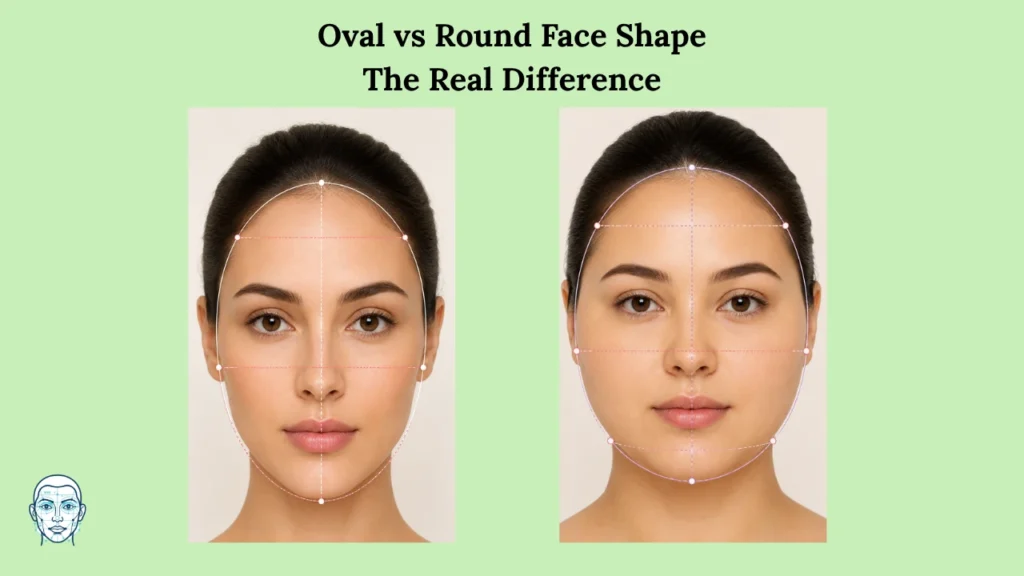
Length. Round faces have a width and length that are close to equal, while oval faces are clearly longer than they are wide. This single measurement is the fastest way to tell the two apart.
What hairstyles suit an oval face best?
Almost all of them — short cuts, medium lengths, long layers, and most bang styles all work without needing to correct any proportion. The main thing to avoid is a cut so voluminous or oversized that it overwhelms the face’s natural balance.
What glasses are best for an oval face?
Rectangular, square, round, cat-eye, and even oversized frames all tend to work well. The two things worth avoiding are very narrow, tall frames (which can exaggerate length) and extremely thick nose bridges (which can compress the mid-face).
Is oval really the most common face shape?
It’s frequently cited as one of the most common shapes across face-shape research and tools, though exact percentages vary by source and dataset — treat any specific number you see as an estimate rather than a fixed fact.
Can an oval face have a big forehead or fuller cheeks?
Yes. Oval refers to overall proportion, not a single fixed look — a fuller/rounder oval, an oval with a larger forehead, or a smaller oval all share the same core ratios while looking a bit different from one another, and each benefits from slightly different specific styling choices.
Analyze You Face Shape, in one Click
Upload one photo and get your face shape — analyzed on your device, nothing ever uploaded anywhere.
Face Shape Analysis →