
What are Nose Shape Types?
Nose shape types are descriptive categories — Roman, Greek, Snub, and so on — used to describe the general profile of a nose based on three things: the curve of the bridge, the shape and angle of the tip, and the width of the base. No single shape is more “normal” or more desirable than another; nose shape varies naturally across everyone, shaped mostly by genetics and ancestry, the same way height or eye color does.
Because these are descriptive labels rather than strict measurements, most real noses blend traits from two categories rather than matching one perfectly — a combination surgeons sometimes just call a “combo” nose. That’s normal, not a sign your nose doesn’t fit anywhere.
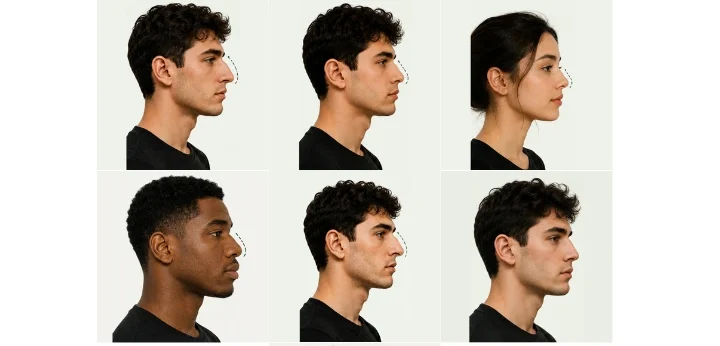
Why So Many Nose Shape Names Exist
Most of these names trace back centuries, borrowed from art, sculpture, and cultural reference points rather than anatomy textbooks — “Roman” and “Greek” both nod to classical sculpture, where each profile was considered a distinct aesthetic ideal in its own artistic tradition. Names like “Button” or “Snub” are far more recent and descriptive, coined simply because they sound like what they describe. None of this history makes one name more legitimate than another; it just explains why the vocabulary is such an inconsistent mix of the ancient and the casual.
How Nose Shape Is Determined
Every nose shape type comes down to the same three measurements, just in different combinations:
Bridge Shape
Viewed from the side: straight, convex (curves outward, a “hump”), or concave (curves inward, a slight dip).
Tip Shape & Angle
Whether the tip is narrow or rounded, and whether it points up, down, or stays level with the bridge.
Base Width
How wide the nose is at the nostrils, relative to the rest of the face.
Combine these three and you get the full range of nose shape types below — a convex bridge with a neutral tip reads as Roman, while the same convex bridge with a downward tip reads as Hawk instead.
The Nose Shape Types, One by One
Here are the most commonly referenced nose shape types and what defines each one:
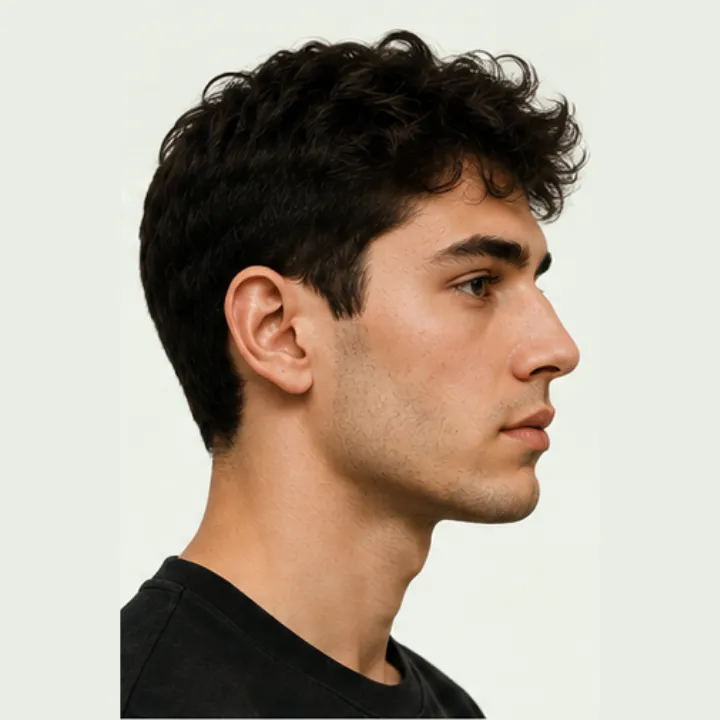
Greek
A close-to-straight bridge with a narrow, well-defined tip — the classic “straight line” profile.
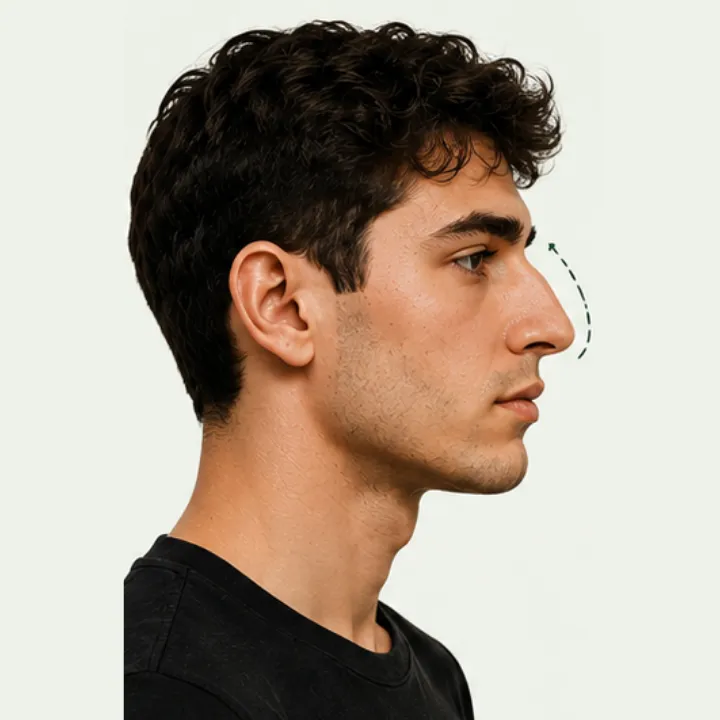
Roman / Aquiline
A clearly convex bridge — a visible outward curve — with a fairly neutral tip angle.
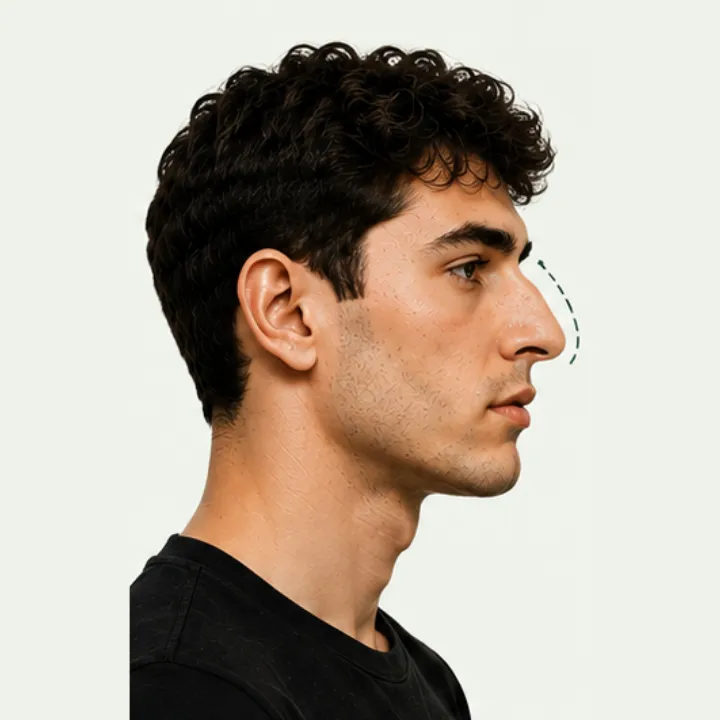
Hawk / Hooked
A strongly convex bridge combined with a downward-curving tip — the most pronounced curved profile.
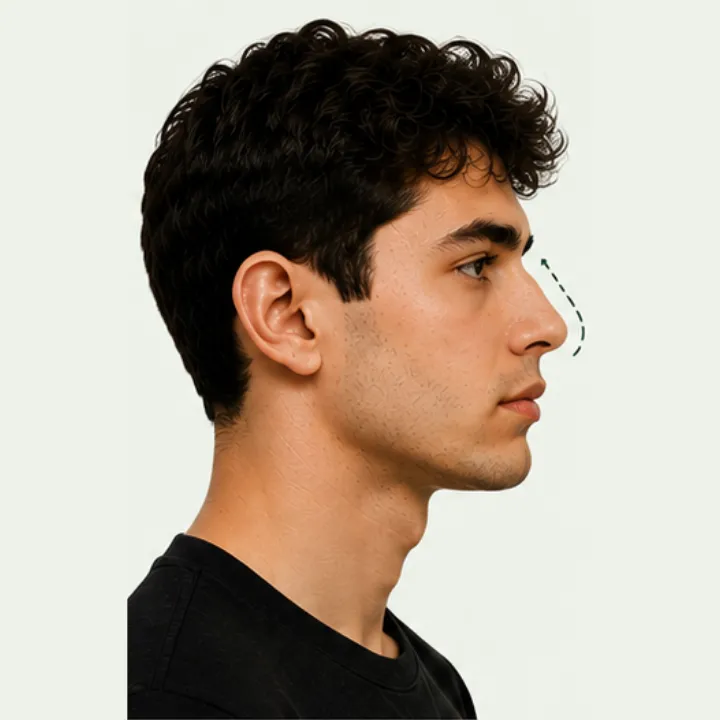
Snub
Short, with a slightly concave bridge and a small tip that sits a touch higher than the bridge line.
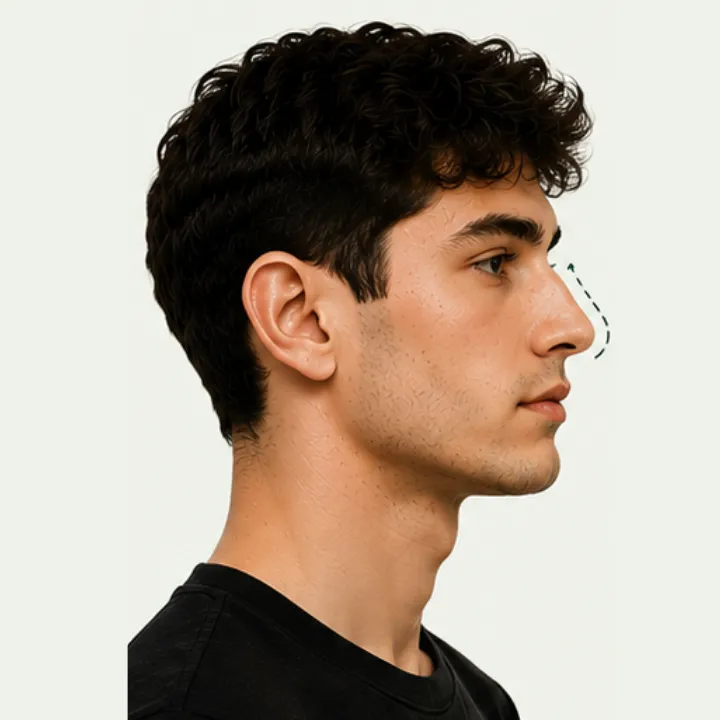
Celestial
A gently concave bridge leading into a naturally lifted, upturned tip.
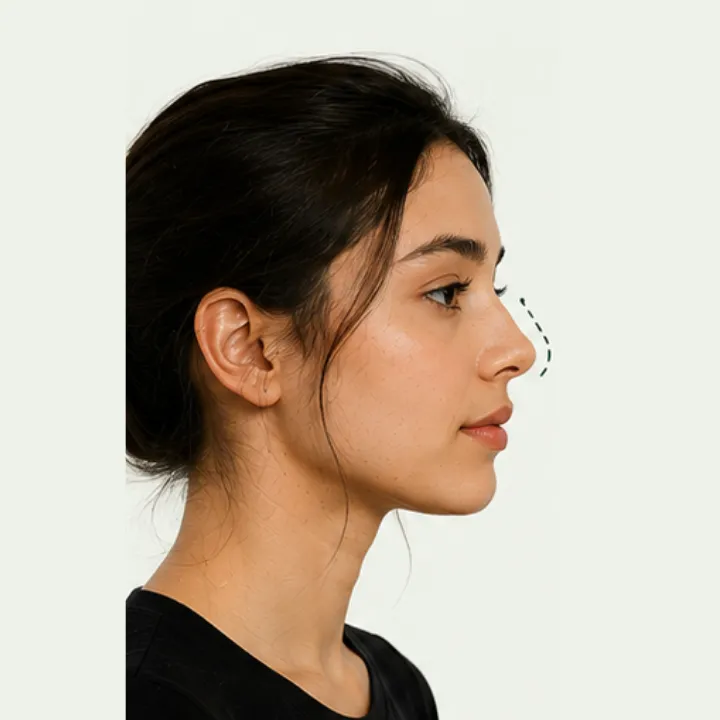
Button
Small, round, and narrow at the bridge, with a soft, undefined tip — overlaps with Snub but emphasizes smallness.
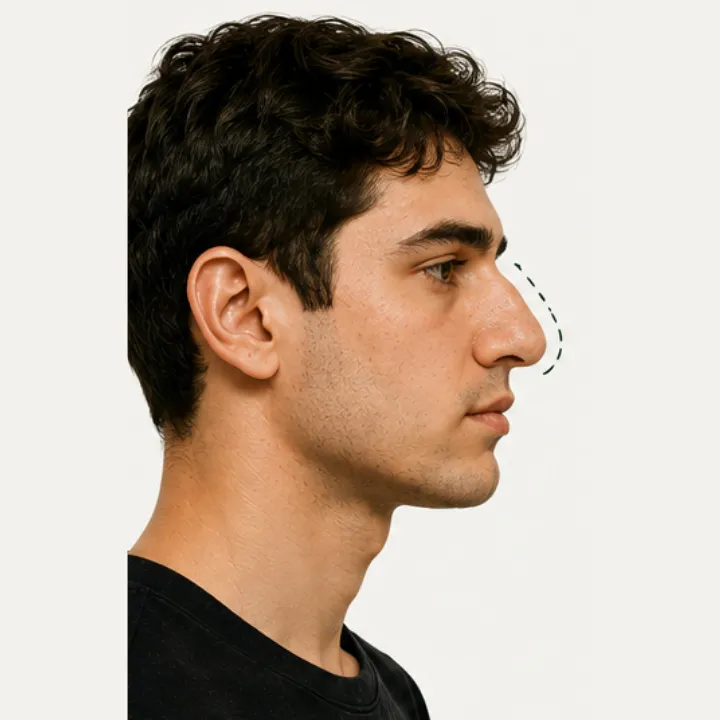
Bulbous
A fuller, rounded tip shaped by the lower cartilage and skin thickness — the tip dominates regardless of bridge shape.
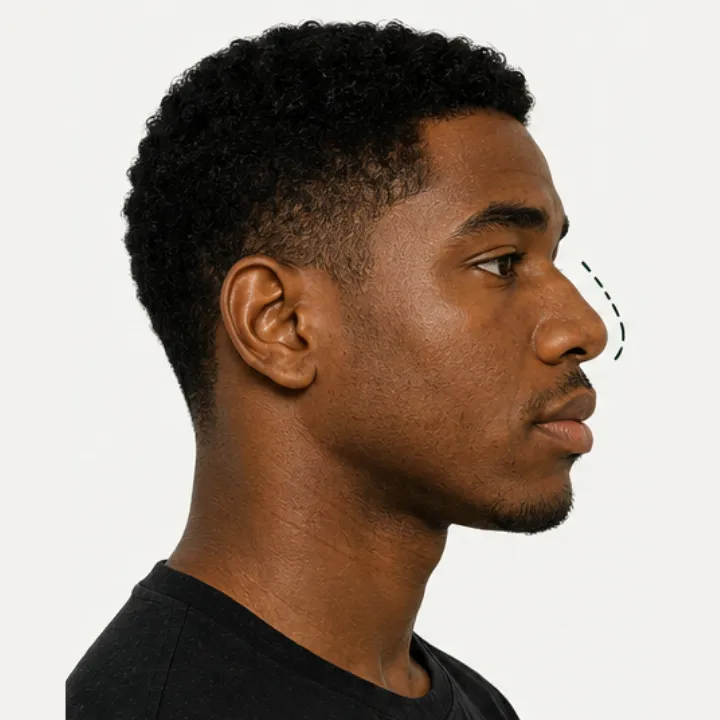
Nubian / Broad
A long, mostly straight bridge over a wider base than average.
Worth knowing: a few additional informal names show up occasionally — a Nixon nose (straight bridge, wider prominent tip), a flat nose (bridge sits lower relative to the cheeks), and a crooked nose (leans to one side, often from injury or a deviated septum). These are less commonly discussed but real, recognized variations.
A little more detail on the eight types above, since the short descriptions only tell part of the story. A Greek nose is often used as the reference point other shapes get compared against, precisely because it has the least going on — no hump, no dip, a tip that neither lifts nor droops. A Roman nose carries real cultural weight historically, frequently associated with classical sculpture and portraiture, though the shape itself is simply a convex bridge like any other variation.
The Hawk nose is essentially Roman taken further — surgeons treating this shape for cosmetic reasons typically focus on reducing the dorsal hump while supporting the tip’s structure, since removing the hump alone can cause the middle of the bridge to collapse inward over time. Snub and Button noses overlap enough that the distinction mostly comes down to emphasis: Snub is defined by shortness and a lifted tip, Button by overall smallness and roundness.
A Celestial nose takes the concave bridge of a Snub nose further, with the tip lifting more noticeably — sometimes called an upturned nose for the same reason. Bulbous noses are defined almost entirely by the tip rather than the bridge, meaning a bulbous tip can appear on top of a straight, convex, or concave bridge alike. Nubian noses are typically longer with a wider base, a combination common across several populations with roots in equatorial climates, where a broader nasal passage historically helped with humidifying air more efficiently.
What Rhinoplasty Can and Can’t Change
Since nose shape types come up often in conversations about rhinoplasty, it’s worth understanding what the surgery can realistically address, purely as background information rather than medical advice. Rhinoplasty can modify bridge height and curve, tip projection and rotation, nostril width, and overall proportions — meaning a Roman nose’s dorsal hump, a Bulbous tip’s width, or a Hawk nose’s downward tip curve are all things the procedure is commonly used to adjust. What it can’t do is guarantee a specific named “type” as an outcome, since results depend entirely on an individual’s existing cartilage, skin thickness, and bone structure — the same factors that produced the original shape in the first place.
Two general surgical approaches exist: structural techniques, which rebuild the nose’s internal framework, and preservation techniques, which work with the existing structure and reshape it more conservatively. Which approach fits a given case depends on the starting anatomy, not personal preference alone — this is exactly the kind of decision that requires an actual consultation rather than anything a guide like this can determine.
Common Misconceptions About Nose Shape Types
A few ideas about nose shape circulate constantly and are worth correcting. First: there’s no such thing as a single “ideal” nose shape that suits everyone — what reads as balanced depends entirely on how a nose relates to an individual’s other features, not on matching a specific named type. Second: nose shape isn’t fixed forever in the way people sometimes assume. Cartilage continues to soften gradually with age, which is why tips can droop slightly and bridges can appear to broaden over decades, even without any intervention.
Third, and this bears repeating: needing a name for your nose shape isn’t a prerequisite for anything. These categories exist to make description easier — useful in a styling or grooming context, useful as shared vocabulary before a consultation — but plenty of people go their whole lives never assigning their nose a label at all, and that’s just as valid an approach.
Are These Actually Clinical Terms?
No — and this is worth being upfront about. Names like Roman, Hawk, and Button are popular shorthand that developed informally over time, not medical classifications. When a surgeon actually documents a nose, they record specific measurements instead: dorsal convexity (how much the bridge curves), tip projection and rotation (how far the tip extends and which direction it points), and alar width (the width at the nostrils). Those terms are precise and measurable; “hawk nose” is a helpful description, not a diagnosis.
That distinction matters if you’re ever discussing your nose with a professional — knowing both vocabularies means you can describe what you see informally, while understanding what’s actually being measured underneath the label.
How to Identify Your Nose Shape
Three checks, using a mirror or a clear side-profile photo, cover most of what determines your type:
- Check the bridge. In profile, trace the line from between your eyes to the tip. Straight suggests Greek; an outward curve suggests Roman or Hawk; an inward curve suggests Snub or Celestial.
- Check the tip. Does it point up, down, or stay level? Upward points toward Celestial or Snub; downward toward Hawk or Roman; level is common across several types.
- Check the base width. From the front, compare your nose’s width at the nostrils to the distance between your eyes. Wider suggests Nubian or Bulbous; narrower suggests Greek or Button.
If you’d rather skip the manual check, an AI nose shape detector runs these same three measurements automatically from a photo, with the numbers shown alongside your result.
Nose Shape and Ethnicity
Nose shape is influenced by genetics and ancestry, the same way height, eye shape, or skin tone are — nasal structure adapted over generations partly in response to climate, since nose shape affects how air is warmed and humidified before reaching the lungs. This means certain shape tendencies do appear more frequently within certain populations. It’s worth treating this as background context rather than a rule: individual variation within any population is substantial, and no shape is more “correct” for anyone. Genetics is one influence among several — cartilage strength, skin thickness, and simple individual variation all play a role too.
Nose Shape Types Often Confused With Each Other
Roman
Convex bridge with a fairly neutral tip angle — the curve is the defining trait, without a strong downward hook.
Hawk
The same convex bridge, but paired with a tip that curves noticeably downward — a more pronounced version of the same underlying shape.
Snub
Short overall length with a slightly concave bridge and a tip that sits a touch higher than the bridge line.
Button
Overlaps heavily with Snub, but the defining trait shifts to smallness and roundness rather than shortness and lift.
Getting an Accurate Read on Your Nose Shape
- ✓ Check bridge shape from a true side profile — it’s nearly invisible from the front.
- ✓ Use even, front-facing light. Overhead light creates shadows that can look like a curve that isn’t really there.
- ✓ Keep hair away from your bridge and tip when checking.
- ✓ Expect a blend — most real noses combine traits from two categories rather than matching one exactly.
Frequently Asked Questions
How many nose shape types are there?
Most guides recognize somewhere between 8 and 12 commonly referenced nose shape types, though some sources list as many as 20 informal variations. There’s no single official count — these are descriptive categories, not a fixed clinical system.
Are nose shape names like “Roman” or “Button” medical terms?
No. Surgeons measure specific traits — bridge curvature, tip projection and rotation, and base width — rather than using these informal names clinically. The popular names are useful shorthand for describing what those measurements add up to.
What determines nose shape?
Nose shape is determined mainly by genetics and ancestry, along with individual differences in cartilage strength and skin thickness. It’s one of the most naturally variable features of the face.
What’s the difference between a Roman nose and a Hawk nose?
Both have a convex, curved bridge. A Roman nose keeps a fairly neutral tip angle, while a Hawk nose combines the same curve with a tip that clearly curves downward.
Can I have more than one nose shape type at once?
Yes — this is actually the norm rather than the exception. Most real noses blend features from two categories, sometimes called a “combo” nose, rather than matching a single type perfectly.
How can I find out my nose shape type without a professional consultation?
Check three things yourself: bridge shape from a side profile, tip angle (up, down, or level), and base width from the front compared to the distance between your eyes. An AI nose shape detector runs these same checks automatically from a photo.
Does nose shape affect breathing?
Nose shape and nasal function are related but distinct — a nose can look a particular way externally while breathing normally, or vice versa. A crooked nose caused by a deviated septum is one case where shape and function are more directly connected.
Is one nose shape type more common than others?
Straight and moderately convex profiles are reported as common across several sources, while more pronounced shapes like Hawk or strongly upturned Celestial noses are referenced less frequently. That said, exact prevalence varies by population and by which classification system a given source uses.
Can nose shape change over time?
Yes, gradually. Cartilage softens with age, which can cause the tip to droop slightly and the bridge to appear broader over decades — a slow structural change rather than something noticeable day to day.
Is any nose shape type “better” than another?
No. Every source consulted for this guide is explicit on this point — nose shape is natural variation, not a hierarchy. What matters more than matching an ideal shape is how a nose relates in proportion to the rest of an individual face.
Where do names like “Roman nose” and “Greek nose” come from?
Most trace back to classical art and sculpture, where these profiles were treated as distinct aesthetic references within their own artistic traditions, rather than to any medical classification system. More recent names like “Button” or “Snub” are simply descriptive rather than historical.
Can two people have the “same” nose shape type but look different?
Yes, easily. Nose shape type describes bridge curve, tip angle, and base width in isolation — it says nothing about size, skin thickness, or how the nose relates to the rest of an individual’s features, all of which shape overall appearance just as much as the type label does.
Curious which type is yours?
Upload a front and side photo and get your nose shape type, with the exact measurements behind the result — all processed on your device.
Try the Nose Shape Detector →